

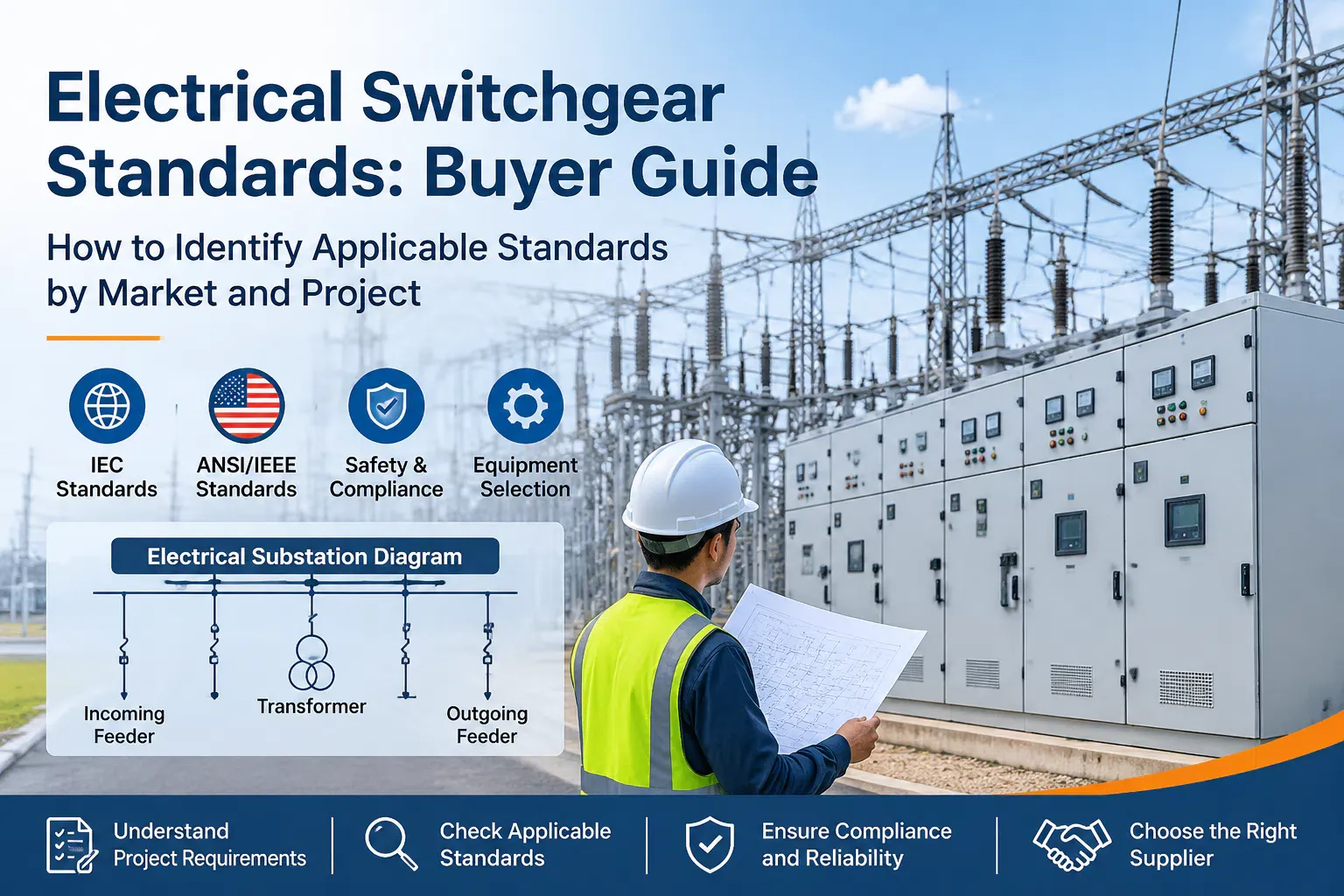
Electrical Switchgear Standards: Buyer Guide
Choosing the right electrical switchgear requires more than comparing prices and technical specifications. Buyers must understand the applicable standards, local regulations, voltage levels, and project requirements before selecting equipment. This Electrical Switchgear Standards: Buyer Guide explains how to identify the correct standards for different markets and industrial applications.
For international projects, understanding electrical standards, design & applications is essential to ensure equipment compatibility, operational safety, and long-term reliability.
1. Why Electrical Switchgear Standards Matter
Electrical switchgear is an essential part of power distribution systems. It protects electrical circuits, controls power flow, isolates faulty equipment, and supports the safe operation of substations and industrial facilities.
Applicable standards define important technical requirements, including:
- Rated voltage and rated current
- Short-circuit breaking and withstand capacity
- Insulation levels and dielectric performance
- Temperature rise and mechanical endurance
- Internal arc classification, where required
- Protection against electric shock and environmental conditions
- Routine tests, type tests, and factory acceptance testing
When selecting industrial electrical equipment, buyers should confirm that the proposed switchgear meets both the relevant international standards and the project's specific technical specifications.
2. Key Electrical Switchgear Standards by Market
Different countries and regions may follow different standards or require additional national regulations. The following standards are common references for medium-voltage and low-voltage switchgear projects.
IEC Standards: International Projects
IEC standards are widely used in Asia, Africa, the Middle East, Europe, and other international markets.
Common references include:
- IEC 62271-1: Common specifications for high-voltage switchgear and controlgear.
- IEC 62271-200: AC metal-enclosed switchgear and controlgear for rated voltages above 1 kV and up to and including 52 kV.
- IEC 61439: Low-voltage switchgear and controlgear assemblies.
- IEC 60947: Low-voltage switchgear and controlgear products.
- IEC 62271-202: Prefabricated substations for high-voltage/low-voltage applications.
These standards help buyers evaluate equipment design, performance, testing, and safety. The exact standard and edition should be confirmed against the project specification.
ANSI/IEEE Standards: North American Projects
Projects in the United States and some other markets may specify ANSI, IEEE, UL, or NEMA requirements, depending on the equipment and application.
Relevant references may include:
- IEEE C37 series: Standards covering various types of switchgear, circuit breakers, and related equipment.
- UL 891: Dead-front switchboards.
- UL 1558: Metal-enclosed low-voltage power circuit breaker switchgear.
Buyers should verify the applicable product category, certification requirements, and local electrical codes before ordering equipment.
Regional and National Requirements
Some projects require compliance with additional national standards, utility specifications, or local authority regulations.
For example, a project in Saudi Arabia may require compliance with the relevant utility's technical specifications. A project in Tanzania or the Philippines may require the applicable national regulations, utility requirements, and project-specific IEC provisions.
Important: An IEC-compliant product is not automatically accepted in every market. Always confirm the complete list of required standards, approvals, and certifications with the project owner or consulting engineer.
3. How to Identify the Applicable Standards for Your Project
Before requesting quotations, buyers should review the following factors.
Step 1: Identify the Destination Market
Determine the country where the switchgear will be installed. Check local electrical regulations, utility requirements, import conditions, and any mandatory product certifications.
This is the first step in an effective equipment selection guide because the destination market can affect both product design and approval procedures.
Step 2: Confirm the Voltage Level and Equipment Type
Different switchgear categories have different technical requirements.
For example:
- 11 kV and 24 kV systems: Medium-voltage switchgear for industrial plants, commercial facilities, and distribution substations.
- 33 kV and 40.5 kV systems: Medium-voltage switchgear commonly used in utility and industrial distribution networks.
- Low-voltage distribution systems: Assemblies used for motor control, power distribution, and building or industrial electrical installations.
The rated voltage, rated current, short-circuit withstand current, and protection requirements must match the system design.
Step 3: Review the Project Specifications and Electrical Substation Diagram
An electrical substation diagram, such as a single-line diagram (SLD), illustrates the main electrical connections, incoming feeders, outgoing circuits, transformers, busbars, and protection arrangements.
When reviewing the diagram, confirm:
- The number and function of incoming and outgoing panels
- Busbar configuration and rated current
- Circuit breaker type and rated breaking capacity
- Current transformers and voltage transformers
- Protection relays, metering, and control requirements
- Interlocking and communication interfaces
Understanding what an electrical substation contains and how its components work together helps buyers select switchgear that fits the complete power distribution system rather than evaluating individual panels in isolation.
Step 4: Confirm Testing and Documentation Requirements
Ask the supplier to identify the standards used for design, manufacture, and testing. Depending on the project, required documents may include:
- Technical data sheets and compliance schedules
- General arrangement drawings and single-line diagrams
- Type-test reports or relevant design verification evidence
- Routine test reports
- Operation and maintenance manuals
- Factory acceptance test (FAT) procedures and reports
- Certificates and approvals required by the project
Clarify whether testing must be witnessed by the buyer, consultant, or third-party inspection agency.
Step 5: Check Environmental and Installation Conditions
Switchgear installed in coastal, tropical, dusty, high-altitude, or outdoor environments may require additional design measures.
Consider the enclosure protection rating, ambient temperature, humidity, corrosion resistance, altitude correction, ventilation, and internal arc requirements where applicable.
These factors are particularly important when selecting industrial electrical equipment for mines, manufacturing plants, renewable energy facilities, and utility substations.
4. Common Mistakes When Buying Electrical Switchgear
Even experienced buyers can encounter problems when standards and project requirements are not clearly defined.
Mistake 1: Specifying only the voltage level.
Two switchgear panels with the same rated voltage may differ significantly in breaking capacity, insulation level, protection features, and testing requirements.
Mistake 2: Assuming all international standards are interchangeable.
IEC, ANSI/IEEE, UL, and national standards have different scopes and requirements. Equivalence should be confirmed technically, not assumed.
Mistake 3: Ignoring utility-specific requirements.
The project owner or local utility may impose additional requirements beyond the general product standard.
Mistake 4: Comparing quotations without checking compliance.
A lower-priced quotation may exclude required protection relays, special testing, certification, or accessories.
Mistake 5: Confirming the order before approving drawings.
The SLD, panel arrangement, interlocking logic, and interface requirements should be reviewed and approved before production begins.
A structured approach to electrical standards, design & applications helps reduce these risks and improves coordination between buyers, consultants, manufacturers, and project owners.
5. Buyer Checklist Before Requesting a Quotation
Use the following checklist to prepare a clear technical inquiry:
- Destination country and project location
- Applicable IEC, ANSI/IEEE, UL, or national standards
- Rated voltage, rated current, and frequency
- Short-circuit breaking and withstand ratings
- Number and function of switchgear panels
- Single-line diagram and required protection scheme
- Indoor or outdoor installation conditions
- Enclosure protection and environmental requirements
- Required tests, certificates, and inspection procedures
- Delivery schedule, warranty, and technical documentation
Providing these details enables suppliers to prepare a more accurate quotation and identify technical deviations at an early stage.
6. Choosing the Right Switchgear Supplier
A reliable switchgear supplier should be able to explain the applicable standards, review project drawings, provide technical documentation, and identify any deviations from the buyer's specifications.
For international projects, buyers should also evaluate manufacturing capabilities, quality control procedures, testing facilities, customization options, and export experience.
At Shandong Dongguan Electric Co., Ltd., we provide electrical power distribution solutions for industrial and utility applications, including medium-voltage switchgear, low-voltage distribution equipment, transformers, and related power quality solutions.
Our team can support project-specific technical discussions, drawing review, equipment configuration, and quotation preparation according to the required standards and application conditions.
Conclusion
Selecting electrical switchgear begins with understanding the destination market, applicable standards, system voltage, short-circuit requirements, and project specifications. A clear technical review helps buyers avoid compliance issues, improve equipment compatibility, and make better purchasing decisions.
Use this Electrical Switchgear Standards: Buyer Guide as a starting point when preparing your next industrial or substation project inquiry.
Need switchgear for your project? Contact our team with your technical specifications or single-line diagram to discuss a suitable solution for your market and application.