

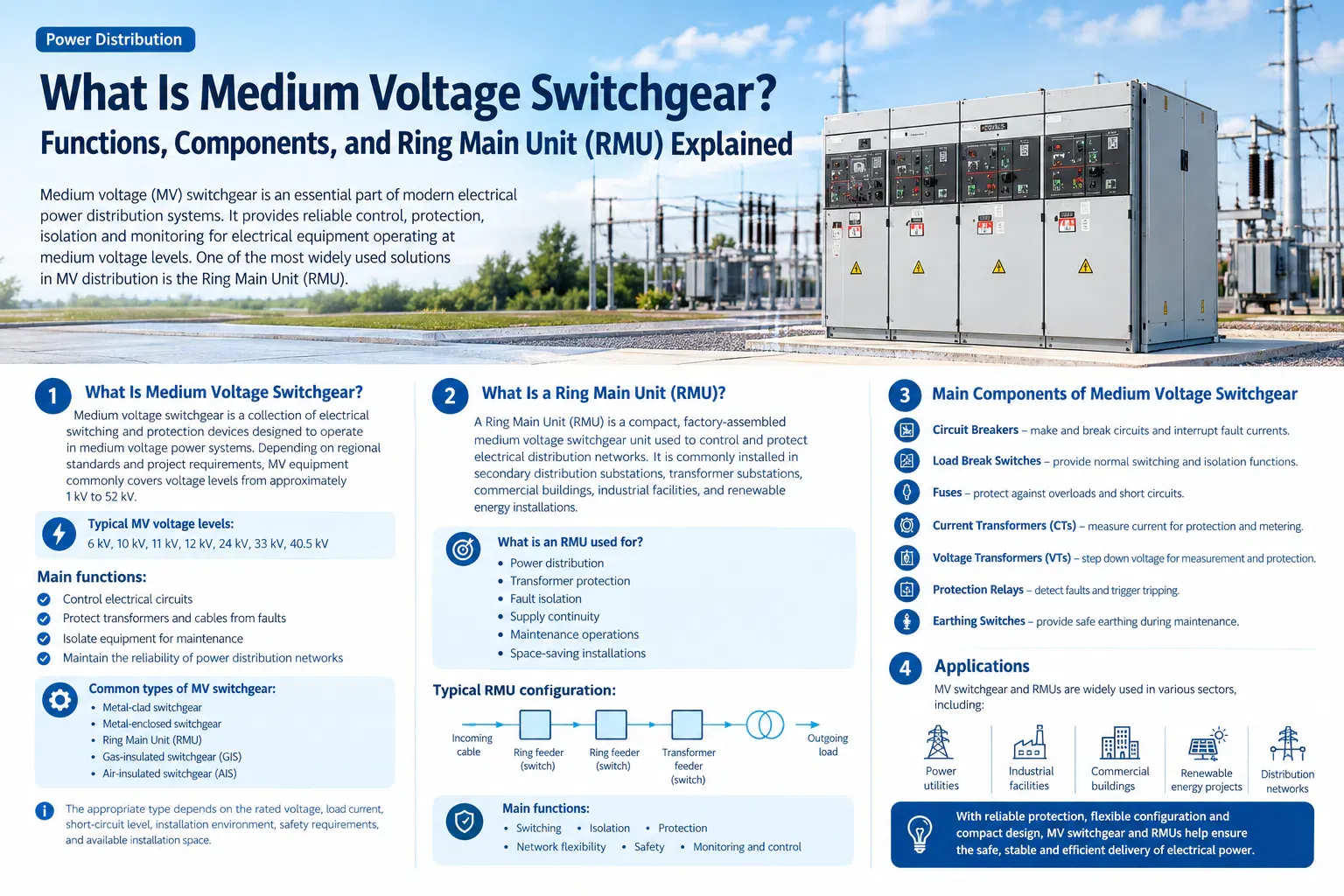
What Is Medium Voltage Switchgear? Functions, Components, and Ring Main Unit (RMU) Explained
Medium voltage (MV) switchgear is an essential part of modern electrical power distribution systems. It provides reliable control, protection, isolation, and monitoring for electrical equipment operating at medium voltage levels. Commonly used in substations, industrial facilities, commercial buildings, renewable energy projects, and utility distribution networks, MV switchgear helps ensure the safe and stable delivery of electrical power.
One of the most widely used solutions in medium voltage distribution is the Ring Main Unit (RMU). But what is a ring main unit, how does it work, and what is the difference between an RMU and conventional medium voltage switchgear?
In this article, we explain the functions, main components, applications, and selection considerations of medium voltage switchgear, with a particular focus on ring main units.
1. What Is Medium Voltage Switchgear?
Medium voltage switchgear is a collection of electrical switching and protection devices designed to operate in medium voltage power systems. Depending on regional standards and project requirements, medium voltage equipment commonly covers voltage levels from approximately 1 kV to 52 kV.
Typical MV switchgear applications include 6 kV, 10 kV, 11 kV, 12 kV, 24 kV, 33 kV, and 40.5 kV power distribution systems.
MV switchgear is designed to control electrical circuits, protect transformers and cables against electrical faults, isolate equipment for maintenance, and maintain the reliability of power distribution networks.
Common types of medium voltage switchgear include:
- Metal-clad switchgear: Provides compartmentalized construction and is widely used in industrial plants, substations, and utility facilities.
- Metal-enclosed switchgear: Houses switching and protection equipment within a grounded metal enclosure.
- Ring Main Unit (RMU): A compact, factory-assembled switchgear solution commonly used in ring and radial distribution networks.
- Gas-insulated switchgear (GIS): Uses gas or another insulating medium to provide compact insulation and switching arrangements.
- Air-insulated switchgear (AIS): Uses air as the primary insulating medium.
The appropriate type depends on the rated voltage, load current, short-circuit level, installation environment, safety requirements, and available installation space.
2. What Is a Ring Main Unit (RMU)?
A Ring Main Unit (RMU) is a compact, factory-assembled medium voltage switchgear unit used to control and protect electrical distribution networks. It is commonly installed in secondary distribution substations, transformer substations, commercial buildings, industrial facilities, and renewable energy installations.
So, what is a ring main unit in electrical power distribution?
An RMU is typically installed at a distribution point where medium voltage cables connect to form a ring network or supply power through a radial arrangement. Its switching devices allow operators to connect, disconnect, and isolate sections of the network when required.
A typical RMU configuration includes two ring cable feeder functions and one transformer feeder function. Depending on the application, additional feeder, metering, or protection functions may also be available.
What Is a Ring Main Unit Used For?
The primary purpose of a ring main unit is to provide safe and reliable switching and isolation in medium voltage distribution systems.
Its main applications include:
- Power distribution: Connecting incoming and outgoing medium voltage cables.
- Transformer protection: Providing a switching and protection interface for distribution transformers.
- Fault isolation: Helping isolate a faulty cable section or connected equipment.
- Supply continuity: Supporting alternative power supply paths in appropriately designed ring networks.
- Maintenance operations: Allowing selected sections of a network to be isolated for inspection or repair.
- Space-saving installations: Providing a compact solution for indoor or outdoor distribution substations.
For example, if a cable section in a properly designed ring network develops a fault, operators may isolate the affected section and restore power to unaffected sections through an alternative route, provided the network configuration and operating conditions allow it.
What Is the Function of a Ring Main Unit?
The main functions of an RMU include:
- Switching: Connecting or disconnecting medium voltage circuits under the operating conditions permitted by the switching device.
- Isolation: Separating a cable, transformer, or other equipment from the energized network for maintenance.
- Protection: Providing or coordinating protection against overloads and short circuits through suitable fuses, circuit breakers, and protection relays.
- Network flexibility: Supporting ring or radial power distribution arrangements.
- Safety: Incorporating interlocks, earthing switches, and other safety features according to the design.
- Monitoring and control: Supporting local or remote monitoring and operation when equipped with the appropriate devices.
Not every RMU includes the same protection functions. For instance, a load-break switch may provide normal switching and isolation functions but does not replace a circuit breaker and protection relay where automatic fault interruption is required.
3. Main Components of Medium Voltage Switchgear
Although the design varies by switchgear type, most MV switchgear systems incorporate several essential components.
3.1 Circuit Breakers
Circuit breakers make and break electrical circuits and interrupt fault currents within their specified ratings. Vacuum circuit breakers are widely used in medium voltage metal-clad switchgear because of their reliable interruption performance and relatively low maintenance requirements.
3.2 Load-Break Switches
Load-break switches are designed to switch normal load currents within their rated operating conditions. They are commonly used in RMUs for incoming and outgoing ring feeders.
A load-break switch should not be assumed to provide the same short-circuit interruption capability as a circuit breaker.
3.3 Disconnectors and Earthing Switches
Disconnectors provide isolation according to their specified operating conditions, while earthing switches connect designated circuit sections to earth to support safe maintenance procedures.
Mechanical and electrical interlocks help prevent unsafe operating sequences.
3.4 Protection Relays and Fuses
Protection relays detect abnormal electrical conditions and initiate circuit breaker tripping when the relevant protection criteria are met. In some RMU configurations, high-voltage fuses provide transformer feeder protection.
The choice between circuit-breaker-based protection and fuse-switch protection depends on transformer ratings, fault levels, coordination requirements, and applicable standards.
3.5 Busbars and Cable Terminations
Busbars distribute electrical power between switching devices within the switchgear assembly. Cable termination compartments provide the interfaces for incoming and outgoing medium voltage cables.
Their insulation, current-carrying capacity, and short-circuit withstand ratings must match the system requirements.
3.6 Instrument Transformers and Monitoring Devices
Current transformers (CTs) and voltage transformers (VTs) provide measurement signals for metering, protection, and monitoring. Depending on the design, switchgear may also incorporate voltage indicators, temperature monitoring, communication interfaces, and remote-control devices.
4. What Is the Difference Between RMU and Conventional MV Switchgear?
Although an RMU is a type of medium voltage switchgear, the two terms are not interchangeable in every application.
| Feature | Ring Main Unit (RMU) | Conventional MV Switchgear |
|---|---|---|
| Main purpose | Compact secondary distribution | Broad range of distribution and control functions |
| Typical construction | Compact, factory-assembled unit | Often modular, with separate functional panels |
| Common applications | Distribution substations, commercial buildings, compact transformer stations | Industrial plants, primary substations, large distribution systems |
| Feeder arrangement | Commonly two ring feeders plus a transformer feeder | Configurable incoming, outgoing, bus coupler, metering, and other panels |
| Switching devices | Often load-break switches, with circuit breakers available in suitable designs | Frequently circuit breakers with protection relays |
| Installation space | Generally compact | Depends on the panel configuration and ratings |
| Expansion | Depends on the RMU design and available modules | Often easier to expand in modular panel systems |
An RMU is often a suitable choice when compact dimensions and straightforward distribution functions are priorities. Conventional metal-clad switchgear may be more appropriate for facilities requiring numerous outgoing feeders, extensive protection schemes, high continuous current ratings, or more complex operational control.
The final selection should be based on the single-line diagram (SLD), electrical ratings, network topology, and project specifications.
5. What Is an RMU in a Substation?
A ring main unit in a substation provides the medium voltage switching interface between the distribution network and downstream equipment, particularly distribution transformers.
For example, in a 10 kV or 11 kV distribution system, an RMU may receive power from an incoming cable, connect to an outgoing ring feeder, and supply a transformer through a dedicated transformer feeder.
A typical three-function RMU may include:
- One incoming ring cable switch.
- One outgoing ring cable switch.
- One transformer feeder with fuse-switch protection or a circuit breaker, depending on the design.
In a ring network, the incoming and outgoing cable connections provide the physical arrangement needed for alternative supply routing. Actual supply continuity depends on the network design, protection coordination, switching procedures, and the availability of an alternative energized source.
RMUs can be installed in compact substations, prefabricated substations, underground distribution facilities, and outdoor enclosures designed for the relevant environmental conditions.
6. What Is an SF6 Ring Main Unit?
An SF6 ring main unit is an RMU that uses sulfur hexafluoride (SF6) gas as an insulating medium and, depending on the design, as part of the switching or arc-interruption system.
SF6-insulated RMUs have traditionally been used because SF6 provides strong insulation performance and enables compact switchgear construction. Sealed gas compartments can also reduce exposure of internal insulation components to external environmental conditions.
However, SF6 is a potent greenhouse gas, and its use is increasingly subject to environmental regulations and equipment lifecycle management requirements. Gas leakage prevention, handling procedures, recovery, and end-of-life management must be considered.
SF6-Free RMU Alternatives
SF6-free RMUs are available for projects seeking to reduce greenhouse gas emissions associated with switchgear. Depending on the manufacturer and voltage class, alternative designs may use clean air, solid insulation, or other approved insulating technologies.
When comparing SF6 and SF6-free RMUs, buyers should evaluate:
- Rated voltage and insulation level.
- Rated normal current and short-time withstand current.
- Switching and fault-interruption capabilities.
- Installation dimensions and cable interfaces.
- Environmental operating conditions.
- Applicable standards and type-test evidence.
- Maintenance requirements and lifecycle costs.
- Local environmental and regulatory requirements.
The most suitable technology depends on the project's technical specifications, operating environment, and lifecycle priorities.
7. What Is a Quad Ring Main Unit?
The term "quad ring main unit" generally refers to an RMU configuration with four functional ways or switching positions, although the exact arrangement varies by manufacturer.
A four-way RMU may include different combinations of ring cable feeders, transformer feeders, circuit breakers, or other switching functions.
For example, a project may require two ring cable ways and two transformer feeder ways. Another application may require additional outgoing feeders or a different combination of switching devices.
Because "quad RMU" is not a universal description of one fixed circuit arrangement, buyers should confirm the required configuration using a single-line diagram rather than relying only on the product name.
8. How to Choose the Right Medium Voltage Switchgear
Selecting the correct MV switchgear is essential for electrical safety, reliable operation, and long-term performance.
Consider the following factors before purchasing.
1. Rated voltage
Confirm the nominal system voltage and the equipment's rated voltage. Common applications include 10 kV, 11 kV, 12 kV, 24 kV, 33 kV, and 40.5 kV systems, depending on the network and equipment design.
2. Rated current
Determine the continuous current required for incoming feeders, outgoing feeders, busbars, and transformer connections.
3. Short-circuit withstand and interruption ratings
Verify the prospective fault current and the required short-time withstand and peak withstand ratings. Circuit breakers must have suitable fault-interruption capabilities for the installation.
4. Protection requirements
Confirm whether the project requires load-break switches, fuse-switch combinations, circuit breakers, protection relays, metering, or additional automation.
5. Installation environment
Consider ambient temperature, humidity, altitude, dust, pollution, corrosion, and indoor or outdoor installation requirements.
6. Applicable standards
Specify the required IEC standards and project-specific requirements. Relevant standards may include IEC 62271-200 for AC metal-enclosed switchgear and controlgear above 1 kV and up to and including 52 kV, and IEC 62271-103 for switches above 1 kV up to and including 52 kV, where applicable to the equipment design.
The applicable edition and any additional product-specific standards should be confirmed for each project.
7. Manufacturer support
Evaluate the manufacturer's technical documentation, design flexibility, testing capabilities, spare parts availability, and after-sales support.
9. Applications of Medium Voltage Switchgear and RMUs
Medium voltage switchgear and RMUs are widely used across different industries.
- Utility distribution networks: Managing incoming and outgoing feeders and supporting distribution network operation.
- Industrial facilities: Supplying power to manufacturing plants, processing facilities, and large electrical loads.
- Commercial buildings: Distributing medium voltage power in office buildings, shopping centers, and business parks.
- Renewable energy projects: Connecting solar power plants, wind farms, and associated transformers to distribution networks.
- Infrastructure projects: Supporting airports, rail systems, water treatment plants, and other essential facilities.
- Residential developments: Providing compact switching solutions for distribution substations serving residential communities.
The equipment configuration should always be selected according to the electrical design, load requirements, protection philosophy, and relevant local regulations.
10. Medium Voltage Switchgear Solutions from Shandong Dongguan Electric Co., Ltd.
Shandong Dongguan Electric Co., Ltd. provides power distribution equipment solutions for industrial, commercial, utility, and infrastructure applications.
Our medium voltage switchgear portfolio can be configured for different voltage levels and project requirements, including KYN28A-12 metal-enclosed switchgear, KYN61-40.5 switchgear, and RMU-related distribution solutions, subject to the required technical configuration.
We support project-specific requirements for:
- Medium voltage switchgear configuration and technical selection.
- Incoming and outgoing feeder arrangements.
- Circuit breaker and protection device selection.
- Technical drawings and single-line diagram coordination.
- Project documentation and export requirements.
- Customized equipment solutions for international markets.
Whether you need a compact RMU for a distribution substation or a modular MV switchgear system for an industrial project, our team can help evaluate the required configuration based on your technical specifications.
Contact Shandong Dongguan Electric Co., Ltd. to discuss your medium voltage switchgear requirements and request a technical proposal.
Website: https://www.dongguanelectric.com/
Frequently Asked Questions (FAQs)
1. What is a ring main unit in electrical power distribution?
A ring main unit is a compact medium voltage switchgear assembly used to connect, switch, and isolate cable feeders and transformer connections in electrical distribution networks.
2. What is the function of a ring main unit (RMU)?
The primary function of an RMU is to provide switching, isolation, and, where appropriately equipped, protection for medium voltage distribution circuits. It can also support supply continuity in properly designed ring networks.
3. What is the difference between RMU and switchgear?
An RMU is a specific type of medium voltage switchgear designed for compact distribution applications. The broader category of MV switchgear also includes metal-clad panels, circuit-breaker panels, and other assemblies for more complex electrical systems.
4. What is an SF6 ring main unit?
An SF6 RMU uses sulfur hexafluoride gas for insulation and, depending on the design, switching or arc interruption. SF6-free alternatives are also available and may be preferred where environmental considerations are important.
5. What is the typical voltage range of an RMU?
RMUs are commonly used in secondary distribution networks at voltage levels such as 10 kV, 11 kV, 12 kV, 24 kV, and 33 kV. The available ratings depend on the manufacturer and product design.
6. Can an RMU protect a distribution transformer?
Yes. An RMU may include a fuse-switch transformer feeder or a circuit-breaker feeder with suitable protection. The appropriate arrangement depends on the transformer rating, prospective fault current, and protection coordination requirements.
7. What information is needed to select an RMU?
Important information includes system voltage, rated current, short-circuit level, number of feeders, transformer capacity, protection requirements, installation environment, and applicable standards.
Conclusion
Medium voltage switchgear plays a critical role in the safe and reliable distribution of electrical power. Among the available solutions, the ring main unit is particularly useful for compact secondary distribution substations and ring network applications.
Understanding what a ring main unit is, what it is used for, and how it differs from conventional MV switchgear helps engineers, contractors, and purchasing teams make informed equipment decisions.
By evaluating electrical ratings, protection requirements, network configuration, environmental conditions, and applicable standards, project teams can select a suitable solution for reliable long-term operation.