

What Is a Static Var Generator (SVG)? A Guide to Industrial Applications and Selection
As industrial facilities become more automated and power systems integrate more renewable energy, maintaining stable voltage and high power quality has become increasingly important. Fluctuating electrical loads, nonlinear equipment, and changing operating conditions can lead to poor power factor, voltage fluctuations, and higher electricity costs.
A Static Var Generator (SVG) is an advanced power electronic device designed to provide dynamic reactive power compensation. For industrial plants, commercial buildings, and renewable energy projects, SVG technology helps improve power factor, stabilize voltage, and support more reliable electrical system operation.
Understanding how an SVG works and how to select the right model is essential for engineers, electrical contractors, system integrators, and industrial equipment buyers.
1. What Is a Static Var Generator (SVG)?
A Static Var Generator (SVG), also known in many applications as a Static Synchronous Compensator (STATCOM), is a power quality device that dynamically supplies or absorbs reactive power to maintain the desired electrical operating conditions.
Unlike conventional capacitor banks that switch fixed compensation steps, an SVG uses power electronic converters to regulate reactive current continuously. This allows it to respond to changing electrical loads more rapidly and precisely.
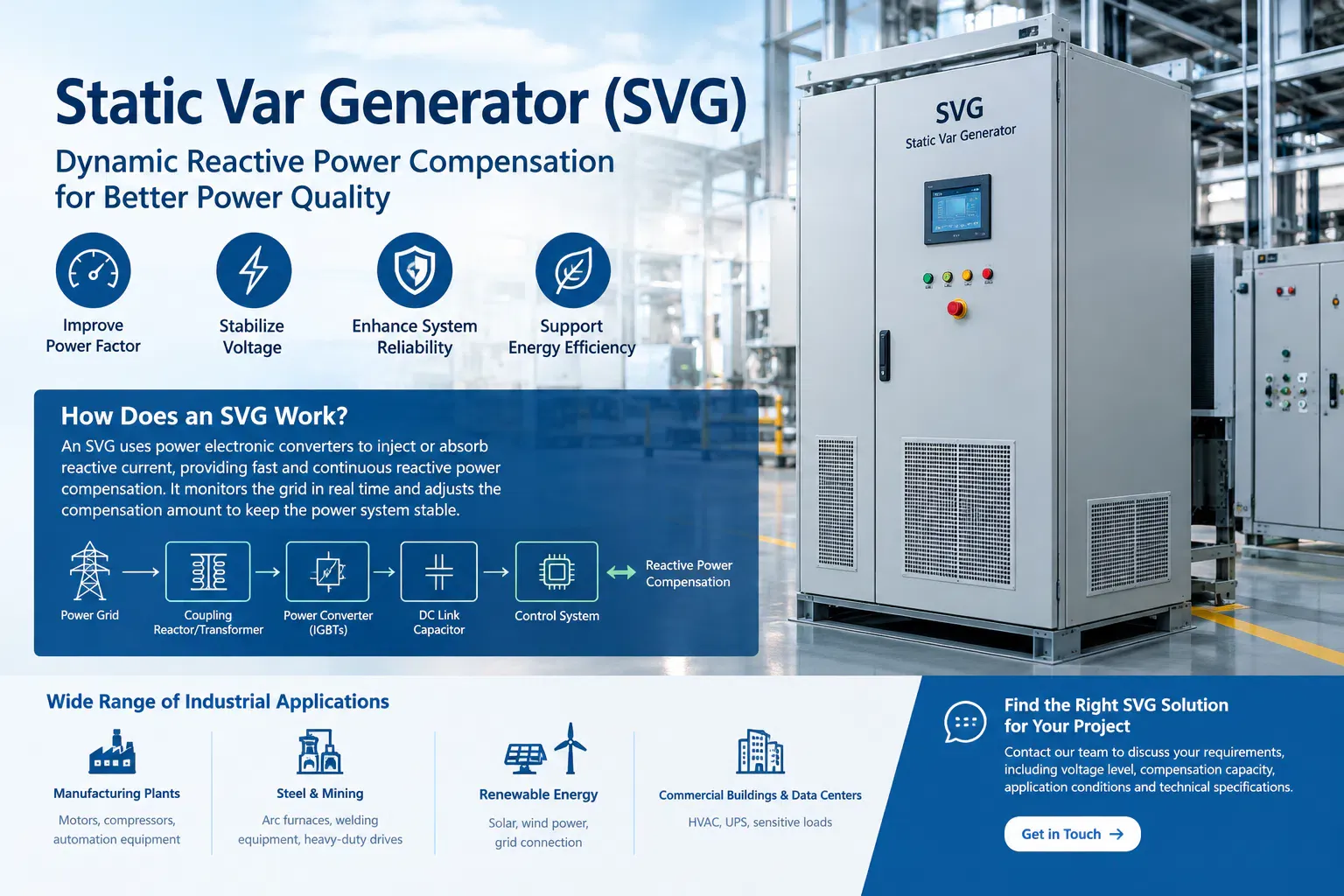
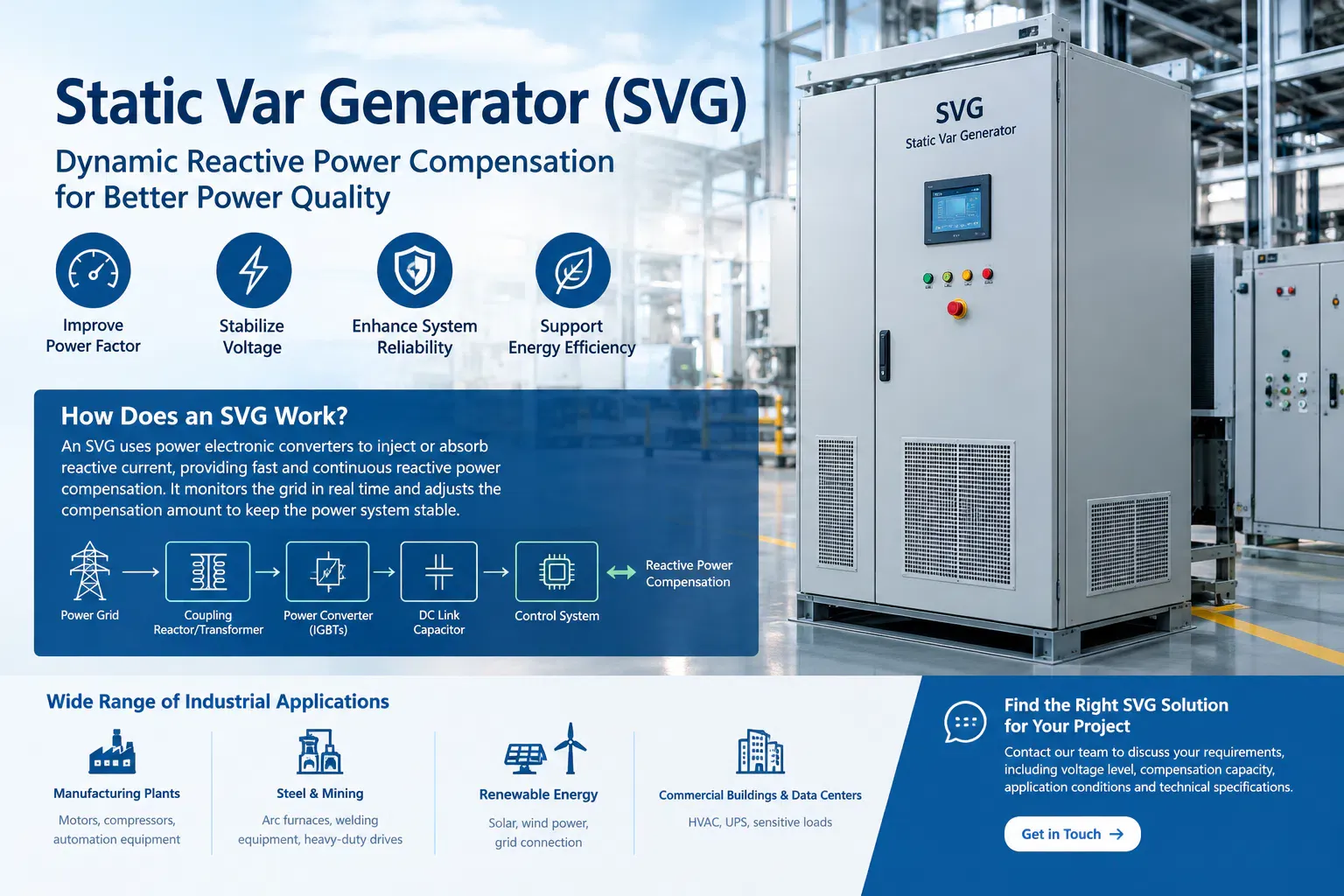
How Does an SVG Work?
An industrial SVG typically consists of the following components:
- Power converter: Uses semiconductor devices, commonly IGBTs, to control the compensating current.
- DC-link capacitor: Maintains the converter's internal DC voltage.
- Control system: Monitors electrical parameters and calculates the required compensation.
- Coupling reactor or transformer: Connects the converter to the electrical network.
- Protection and cooling systems: Help ensure safe operation and manage heat generated during operation.
The SVG continuously monitors the electrical system. When a load requires additional reactive power, the converter injects compensating current. When the system has excess capacitive reactive power, the SVG can absorb it.
This bidirectional operation helps maintain a more stable power factor and supports voltage regulation under changing load conditions.
2. Why Is SVG Technology Important for Industrial Power Quality?
Industrial facilities often operate motors, welding machines, variable-frequency drives, pumps, compressors, and other equipment with significant or fluctuating reactive power demand.
Without appropriate compensation, these loads may increase current flowing through cables and transformers, contribute to voltage fluctuations, and reduce the effective capacity of electrical infrastructure.
An industrial Static Var Generator can provide several benefits.
Improved Power Factor
Reactive power compensation reduces the reactive current drawn from the supply. This can improve power factor and help industrial users meet utility requirements for reactive power management.
Faster Dynamic Compensation
Compared with conventional stepped capacitor banks, SVG systems can respond continuously to rapid load changes. This is particularly valuable in steel production, mining, manufacturing, and other applications with fluctuating electrical demand.
Enhanced Voltage Stability
By supplying or absorbing reactive power, an SVG helps regulate voltage at the point of connection. This supports stable operation of electrical equipment, especially where loads vary significantly.
Better Electrical System Utilization
Reducing unnecessary reactive current can release capacity in transformers, cables, and distribution equipment. The actual benefit depends on the existing system design, load profile, and compensation strategy.
Important: An SVG primarily addresses reactive power. Although some SVG systems offer harmonic compensation functions, buyers should confirm the specified harmonic mitigation capability. Dedicated Active Power Filters (APFs) or hybrid SVG/APF solutions may be necessary when harmonic distortion is a major concern.
3. Industrial Applications of Static Var Generators
The demand for industrial power quality solutions is influenced by automation, electrification, renewable energy integration, and increasingly sensitive electrical loads.
Common SVG applications include:
Manufacturing and Industrial Plants
Production lines, induction motors, compressors, and automated machinery can create fluctuating reactive power demand. SVG systems help maintain power factor and improve electrical operating conditions.
Steel, Welding, and Mining Industries
Electric arc furnaces, welding equipment, crushers, and heavy-duty drives may produce rapid load changes and voltage fluctuations. Dynamic reactive power compensation can help reduce these disturbances.
Renewable Energy Systems
Solar photovoltaic plants and wind power installations may require reactive power support to meet grid connection requirements. Depending on system voltage and project specifications, low-voltage SVG, medium-voltage SVG, or utility-scale STATCOM solutions may be appropriate.
Commercial Buildings and Data Centers
HVAC systems, UPS equipment, and other electrical loads can create reactive power demand. SVG solutions can support power factor correction and improve the utilization of electrical distribution systems.
4. SVG Market Trends and Industry Outlook
The global SVG market is developing alongside demand for improved power quality, renewable energy integration, and modern grid infrastructure.
According to Global Info Research's report published in July 2026, the global Static Var Generator market was valued at approximately US$1.042 billion in 2025 and is forecast to reach approximately US$1.420 billion by 2032, representing a projected compound annual growth rate (CAGR) of 4.0%.
These figures are third-party market research estimates, not audited industry totals, and other research providers may report different market sizes because of variations in product scope and methodology.
Several trends are shaping the market:
- Digital control and monitoring: More SVG systems incorporate intelligent controllers, communication interfaces, and remote monitoring functions.
- Modular system design: Modular configurations can simplify capacity expansion, installation, and maintenance.
- Renewable energy integration: Solar and wind projects increasingly require effective voltage and reactive power management.
- Integrated power quality solutions: Buyers are evaluating SVG, APF, and hybrid compensation systems to address reactive power and harmonic problems together.
For industrial buyers, these trends make application-specific engineering and technical compatibility increasingly important when comparing suppliers.
5. SVG Selection Guide: Key Factors for Industrial Buyers
Selecting the right Static Var Generator requires more than choosing a rated capacity. Buyers should evaluate the complete electrical system and the project's operating requirements.
5.1 Confirm System Voltage
Identify the actual network voltage and frequency before selecting a model. Low-voltage systems commonly use SVG equipment connected to 380 V, 400 V, or 415 V networks, while medium-voltage applications may require specially designed systems and coupling arrangements.
Always verify compatibility with local electrical standards and project specifications.
5.2 Calculate Reactive Power Compensation Capacity
Determine the required compensation capacity in kvar or Mvar based on measured load data, existing power factor, target power factor, and expected load variation.
A preliminary estimate can be calculated using:
Required compensation (kvar) = Active power (kW) × [tan(arccos PF₁) − tan(arccos PF₂)]
Here, PF₁ is the existing power factor and PF₂ is the target power factor.
For example, a 500 kW load improving from a power factor of 0.80 to 0.95 would require approximately 237 kvar of compensation under the stated assumptions.
This is a preliminary calculation. Final sizing should account for load fluctuations, harmonics, existing capacitors, system impedance, and the desired operating margin.
5.3 Evaluate Response Time and Load Characteristics
Fast-changing loads may benefit from SVG technology's rapid, continuous response. Buyers should request the manufacturer's specified response time and verify that it meets the application's requirements.
5.4 Check Harmonic Conditions
If the installation contains variable-frequency drives, rectifiers, or other nonlinear loads, obtain a harmonic assessment before selecting equipment.
An SVG should not automatically be considered a complete harmonic filter. Confirm whether separate APF equipment or an integrated solution is required.
5.5 Review Installation and Communication Requirements
Confirm cabinet dimensions, ventilation, ambient temperature, altitude, protection rating, maintenance access, and available communication protocols.
For export projects, also verify certification requirements, applicable IEC or local standards, documentation, spare parts availability, and after-sales technical support.
6. From Manufacturing to Commissioning: What Buyers Should Expect
A reliable industrial SVG solution involves more than assembling power electronic components.
The process typically begins with application assessment and electrical parameter analysis. Engineers then select the converter topology, compensation capacity, control configuration, and protection functions.
During manufacturing, power modules, control boards, reactors, cooling components, and protective devices are assembled and inspected. Quality checks may include wiring verification, functional testing, protection checks, and performance testing according to the agreed technical specification.
After delivery, qualified personnel install the SVG at the designated connection point, verify electrical connections and protection settings, and commission the control system under actual operating conditions.
Buyers should request relevant test reports, wiring diagrams, installation instructions, and commissioning guidance before placing an order.
7. Frequently Asked Questions (FAQ)
Q1: What is the difference between an SVG and a capacitor bank?
A capacitor bank typically provides compensation in fixed or switched steps. An SVG electronically adjusts reactive current continuously, making it more suitable for rapidly changing loads. The best choice depends on load characteristics, technical requirements, and total lifecycle cost.
Q2: Can an SVG reduce electricity costs?
An SVG can help reduce reactive power penalties where utility tariffs apply and may reduce current-related losses. Actual savings depend on the local tariff structure, load profile, equipment efficiency, and installation costs. It does not directly reduce the active energy consumed by the production process.
Q3: How do I determine the correct SVG capacity?
Start with measured active power, existing and target power factors, load variation, and the required compensation range. A power quality assessment is recommended for installations with fluctuating loads or significant harmonics.
Q4: Can an SVG and an APF be used together?
Yes. An SVG can provide dynamic reactive power compensation, while an APF targets harmonic currents. A combined SVG/APF solution may be suitable when both problems are present, provided the system is correctly sized and configured.
Conclusion: Choose the Right SVG for Your Project
A Static Var Generator is an important solution for improving industrial power quality, managing reactive power, and supporting stable electrical operation. However, the right equipment depends on network voltage, compensation capacity, load characteristics, harmonic conditions, and project-specific requirements.
For industrial plants, electrical contractors, distributors, and system integrators, careful technical evaluation before purchasing can help improve equipment compatibility and long-term performance.
Looking for a suitable SVG solution for your project? Contact our team to discuss your voltage level, required compensation capacity, application conditions, and technical specifications. We can help you evaluate the appropriate industrial power quality equipment for your project.