

What Is an Active Power Filter (APF)? Working Principle, Types, Applications and Selection Guide
Active Power Filters (APFs) are widely used in industrial power systems to reduce harmonic distortion, improve power quality, and support stable equipment operation. As modern factories increasingly use variable frequency drives, rectifiers, UPS systems, and other nonlinear loads, harmonic problems have become a major concern for electrical engineers and facility managers.
What is an active power filter, and how can it improve power quality in industrial applications? This article explains active power filter technology, its working principle, common types, applications, and the key factors to consider when selecting an APF system.
1. What Is an Active Power Filter (APF)?
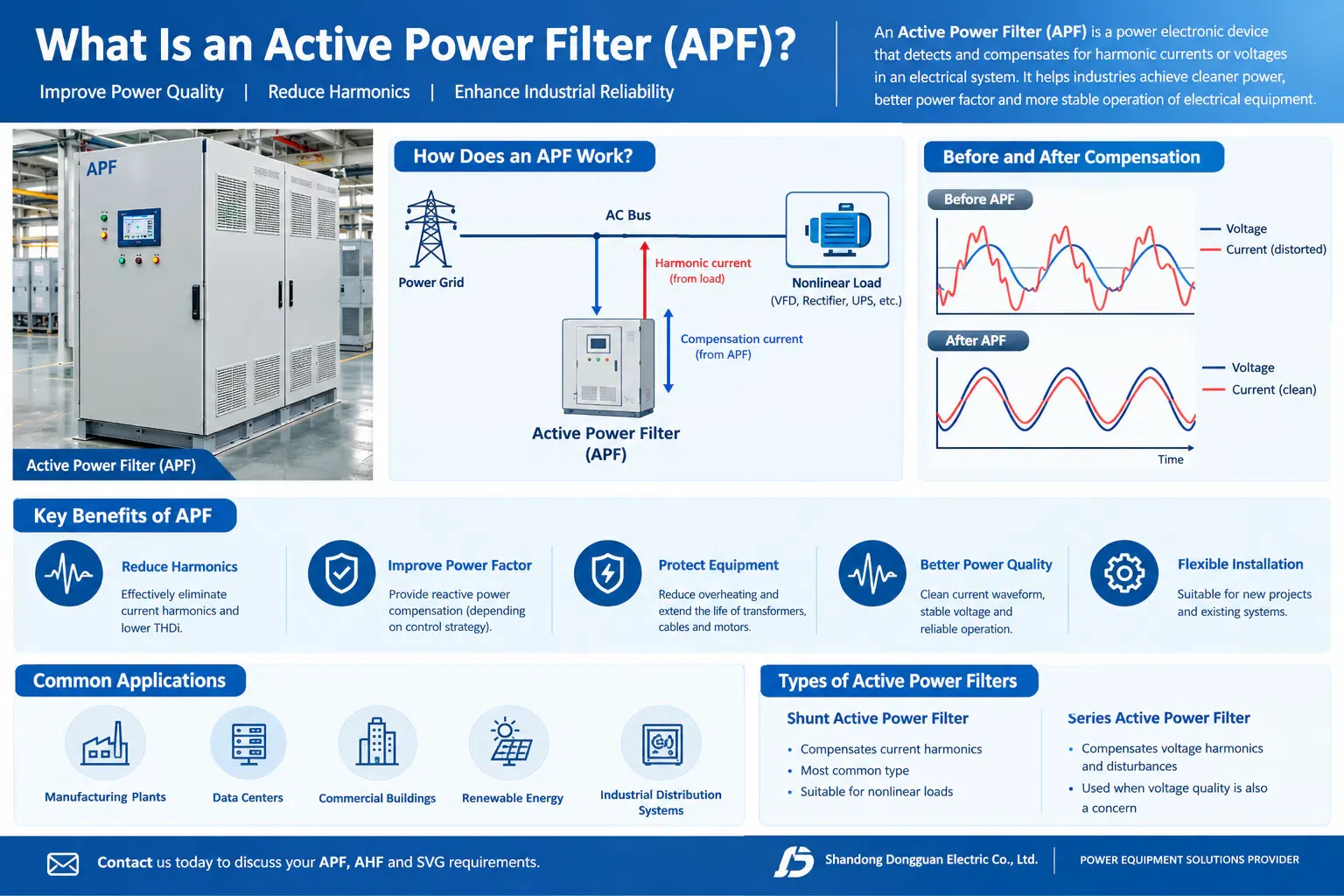
An active power filter (APF) is a power electronic device designed to detect and compensate for harmonic currents or voltages in an electrical system. In most industrial applications, a shunt active power filter is used to reduce current harmonics generated by nonlinear loads.
If you are searching for what is an active power filter, what is active power filter, or what is an active harmonic filter, these terms generally refer to equipment that actively compensates for unwanted harmonic components in electrical systems.
Unlike conventional passive filters, which use fixed combinations of capacitors, inductors, and resistors, an active harmonic filter uses power electronics and real-time control algorithms to generate compensation currents according to the detected harmonics.
An APF can help:
- Reduce harmonic distortion in electrical networks.
- Improve current waveform quality.
- Reduce the risk of overheating in transformers, cables, and other electrical equipment caused by excessive harmonic currents.
- Support more reliable operation of sensitive electrical equipment.
- Improve overall power quality in industrial facilities.
The actual performance depends on the APF rating, system configuration, harmonic spectrum, and installation conditions.
2. How Does an Active Harmonic Filter Work?
To understand what an active harmonic filter does, it is important to understand how harmonics are generated.
Nonlinear loads draw nonsinusoidal current from the power supply. Common examples include variable frequency drives (VFDs), industrial rectifiers, UPS systems, welding machines, and switching power supplies.
These distorted currents can cause voltage distortion, additional electrical losses, equipment overheating, and interference with sensitive devices.
An active harmonic filter typically works through three steps:
Step 1: Harmonic detection
Current sensors monitor the electrical system and collect information about the load current. A control system identifies the harmonic components that need compensation.
Step 2: Compensation current generation
The APF controller calculates the required compensation current. Its power converter then generates a current waveform designed to counteract the targeted harmonic components.
Step 3: Harmonic current compensation
The APF injects the compensation current into the electrical network. This reduces the harmonic current supplied by the upstream power source and improves the overall current waveform.
The result is a cleaner current waveform and improved power quality, provided that the filter is correctly sized and configured for the application.
3. What Is a Shunt Active Power Filter?
A shunt active power filter is the most common type of APF used for industrial harmonic mitigation.
It is connected in parallel with the nonlinear load or at a suitable point in the distribution system. The filter detects harmonic currents and injects compensating currents to reduce the harmonics flowing through the upstream supply.
Advantages of a Shunt Active Power Filter
- Effective compensation of multiple harmonic orders within its operating capacity.
- Dynamic response to changing load conditions.
- Suitable for industrial systems with fluctuating harmonic currents.
- Potential to provide reactive power compensation, depending on the control strategy and available capacity.
- Flexible integration into existing low-voltage distribution systems.
For factories with multiple VFDs, rectifiers, and other nonlinear loads, a shunt active power filter can be installed near the major harmonic source or at a common distribution point.
The best installation location depends on the load arrangement, the required compensation level, cable layout, and the desired power quality results.
4. What Is a Series Active Power Filter?
A series active power filter is connected in series with the electrical supply path and is primarily designed to compensate for voltage-related power quality problems.
Depending on its design, a series active filter can help mitigate voltage harmonics, voltage disturbances, and certain supply-side power quality issues.
The main difference between shunt and series active power filters is their compensation target:
- Shunt active power filter: Primarily compensates for load current harmonics.
- Series active power filter: Primarily compensates for supply voltage disturbances and voltage harmonics.
For many industrial facilities experiencing current harmonics from nonlinear loads, a shunt APF is the more common choice. A series filter or a combined series-shunt configuration may be considered when voltage quality is also a major concern.
5. What Is the Use of an Active Harmonic Filter?
If you are asking what is the use of active harmonic filter technology, its main purpose is to reduce harmonic distortion and help electrical systems operate more reliably.
Typical applications include:
Manufacturing Plants
Factories using CNC machines, VFD-driven motors, automated production lines, and industrial rectifiers may experience significant harmonic currents. APFs help reduce these harmonics and support stable operation.
Data Centers
UPS systems and other power electronic loads can generate harmonic currents. An APF may help improve current quality when properly integrated into the facility's electrical design.
Commercial Buildings
Large buildings with elevators, HVAC systems, LED lighting, and electronic equipment may benefit from harmonic mitigation when measurements indicate a power quality problem.
Renewable Energy Systems
Solar power installations and other inverter-based systems may require harmonic analysis and mitigation depending on the inverter characteristics and grid connection requirements.
Industrial Power Distribution Systems
APFs can be applied to distribution panels, motor control centers, and other suitable locations to address harmonic problems identified through power quality measurements.
6. Active Harmonic Filter and Power Factor Correction
The relationship between an active harmonic filter and power factor correction is an important consideration in industrial power quality management.
Harmonic distortion and poor power factor are related but different problems.
Displacement power factor is associated with the phase difference between the fundamental-frequency voltage and current. Harmonic distortion can also reduce the overall true power factor by increasing RMS current without contributing proportionally to useful active power.
An active harmonic filter can compensate for harmonic currents and, when supported by its control functions, provide reactive current compensation to improve power factor.
However, an APF is not automatically a complete replacement for a dedicated capacitor bank or an SVG system. The appropriate solution depends on the load characteristics, reactive power demand, harmonic levels, and control requirements.
A practical comparison is shown below:
| Solution | Main function | Typical application |
|---|---|---|
| APF | Dynamic harmonic current compensation | Nonlinear industrial loads |
| Automatic capacitor bank | Fundamental-frequency reactive power compensation | Relatively stable reactive power demand |
| SVG | Dynamic reactive power compensation | Rapidly changing reactive power demand |
| APF + SVG | Harmonic mitigation and dynamic reactive power compensation | Facilities with both harmonic and reactive power problems |
When evaluating active harmonic filter power factor correction requirements, engineers should consider the total load profile and determine whether an APF alone or a combined APF and SVG solution is more appropriate.
7. Active Harmonic Filter and Power Optimizer: What Is the Difference?
An active harmonic filter and a power optimizer serve different purposes.
An active harmonic filter focuses on power quality by compensating for harmonic currents and, in some designs, reactive current.
A power optimizer is a broader term that may refer to equipment or systems designed to optimize energy use, electrical performance, or power conversion, depending on the product category.
Therefore, an active harmonic filter and power optimizer should not be treated as interchangeable terms. Before selecting equipment, users should identify the specific electrical problem they need to solve.
For example, if a factory experiences high current THDi caused by nonlinear loads, an APF may be an appropriate solution. If the objective is to improve solar module energy harvesting or optimize energy consumption, a different type of power optimizer may be required.
8. Active Harmonic Filter Power Theory and Compensation Capacity
Active harmonic filter power theory is based on detecting unwanted current components and using a controlled power converter to inject compensating currents.
In a typical shunt APF, the control system measures load current and separates the harmonic components from the desired fundamental current. The converter then generates a compensation current that counteracts the targeted harmonics.
The compensation capability depends on several factors:
- Rated compensation current, usually expressed in amperes.
- Harmonic spectrum and magnitude of the load.
- Load variation and transient operating conditions.
- Installation point and electrical system impedance.
- Required harmonic reduction and applicable power quality limits.
- Whether reactive power compensation is also required.
The rated current of an APF should be selected based on actual harmonic current measurements and engineering calculations rather than total transformer capacity alone.
If the nonlinear load changes significantly throughout the day, engineers should assess peak harmonic demand and allow appropriate design margin.
9. How to Select an Active Power Filter for Industrial Applications
Choosing the right APF requires an understanding of the electrical system and the specific power quality problem.
1. Measure Harmonic Distortion
Conduct a power quality survey to determine current THDi, voltage THDv, harmonic orders, and load variation. Measurement results help establish the required compensation performance.
2. Determine the Required Compensation Current
Estimate the harmonic current that needs to be compensated and select an APF with a suitable rated current. Consider future load expansion and simultaneous operation of multiple nonlinear loads.
3. Confirm Voltage and System Frequency
Verify the rated voltage, three-phase configuration, frequency, grounding arrangement, and compatibility with the existing distribution system.
4. Select the Installation Location
The APF may be installed near an individual nonlinear load or at a common busbar or distribution panel. Local installation can address specific equipment, while centralized installation can compensate for aggregated harmonic currents.
5. Evaluate Control and Monitoring Functions
Check the available harmonic compensation range, response characteristics, communication interfaces, display functions, and compatibility with the plant's monitoring system.
6. Consider Environmental and Installation Conditions
Review ambient temperature, ventilation, enclosure protection, installation space, and maintenance requirements. These factors are especially important in demanding industrial environments.
7. Check Compliance and Technical Documentation
Confirm the applicable standards, test documentation, protection functions, and project-specific technical requirements before placing an order.
For projects requiring APF, SVG, or other power quality equipment, a detailed technical assessment helps ensure that the proposed system matches the actual operating conditions.
10. What Is an Active Power Filter? Frequently Asked Questions
What is an active power filter according to Wikipedia?
Readers searching for what is active power filter Wikipedia are generally looking for a basic technical definition. An active power filter is a power electronic device that compensates for unwanted harmonic components in an electrical system. Unlike a fixed passive filter, it can adjust its compensation according to measured operating conditions.
What does an active harmonic filter do?
It detects harmonic components and generates compensating currents or voltages, depending on the topology. Shunt active harmonic filters are mainly used to reduce current harmonics caused by nonlinear loads.
What is meant by a shunt active power filter?
A shunt active power filter is connected in parallel with a load or distribution bus and injects compensating current to reduce harmonic currents in the supply system.
What is the difference between a shunt active power filter and a series active power filter?
A shunt filter primarily addresses current harmonics, while a series filter primarily addresses voltage-related disturbances and harmonics. The appropriate type depends on the power quality issue.
Can an active harmonic filter improve power factor?
Yes, an APF with suitable reactive current compensation functionality can improve power factor. The actual improvement depends on the APF's available capacity and the facility's reactive power demand.
Is an Ablerex active power filter the only option?
No. An Ablerex active power filter is one branded option in the market. Buyers can also evaluate other manufacturers based on rated current, harmonic compensation performance, system compatibility, technical documentation, service support, and total project cost. The best choice depends on the application rather than the brand name alone.
Is there a 3 phase shunt active power filter project report available?
A 3 phase shunt active power filter project report typically covers the circuit topology, harmonic detection algorithm, control strategy, simulation or experimental results, and harmonic compensation performance. For an industrial project, a measured power quality report and an equipment-specific technical proposal are usually more useful for selecting the actual APF capacity.
Conclusion: Choose the Right APF for Better Power Quality
An active power filter is an effective solution for reducing harmonic currents in industrial electrical systems. By detecting and compensating for unwanted harmonic components, APF technology can help reduce harmonic-related electrical losses, improve current waveform quality, and support reliable operation of industrial equipment.
Understanding the difference between shunt and series active power filters, the relationship between active harmonic filters and power factor correction, and the key selection factors is essential for developing an appropriate power quality solution.
Shandong Dongguan Electric Co., Ltd. provides power quality solutions, including Active Power Filters (APF) and Static Var Generators (SVG), for industrial and commercial applications.
If your facility is experiencing harmonic distortion, poor power factor, or unstable electrical performance, contact our team to discuss your project requirements. We can help evaluate your application and recommend a suitable power quality solution based on your system parameters.
Contact us today to discuss your APF, AHF, and SVG requirements.
Shandong Dongguan Electric Co., Ltd. — POWER EQUIPMENT SOLUTIONS PROVIDER.