

What Is a Low Voltage Distribution Box? Functions, Components, Applications, and Selection Guide
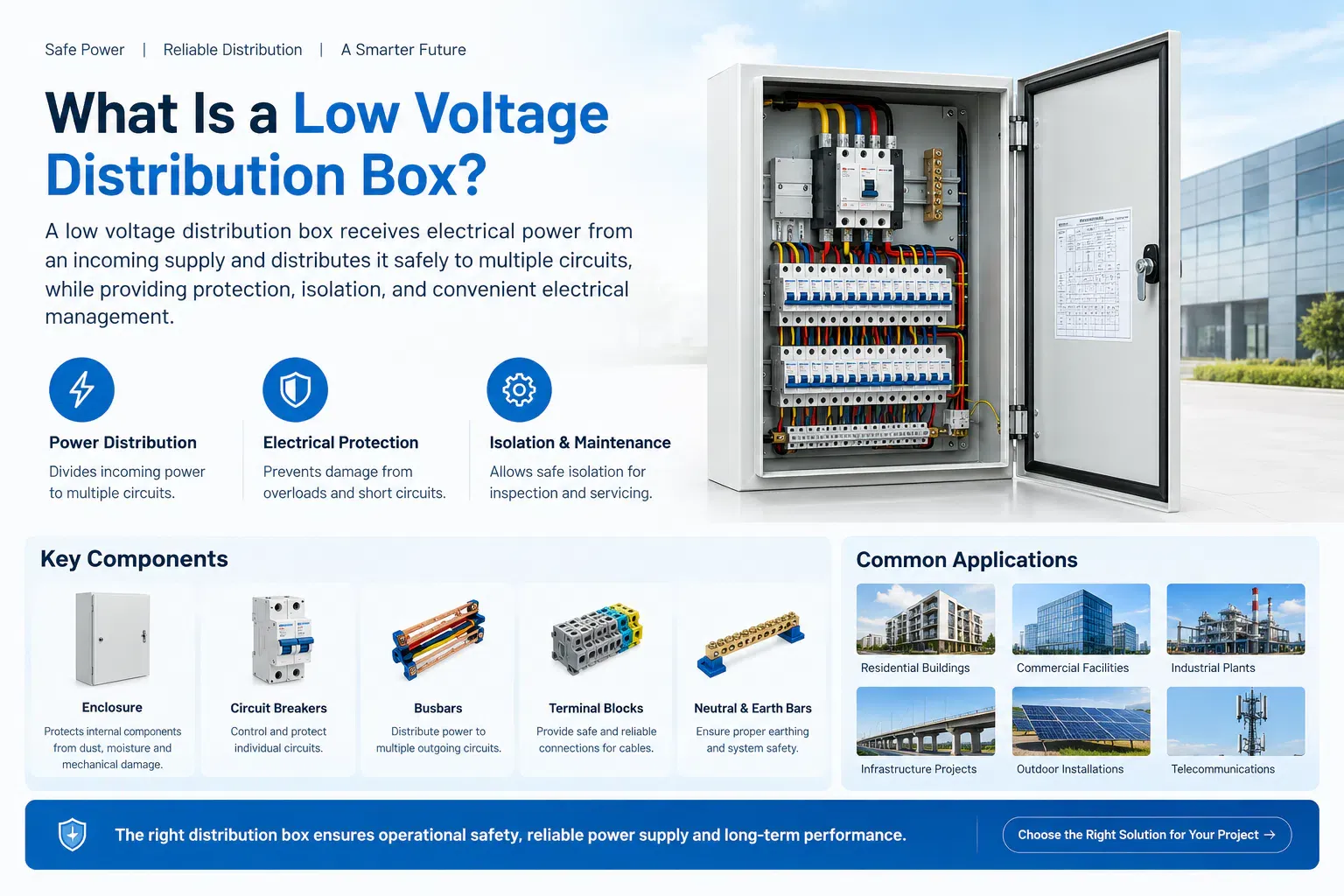
A low voltage distribution box is an essential part of electrical power distribution systems. It receives electrical power from an incoming supply and distributes it safely to multiple circuits, while providing protection, isolation, and convenient electrical management. Low voltage distribution boxes are widely used in residential buildings, commercial facilities, industrial plants, infrastructure projects, and outdoor electrical installations.
For electrical contractors, project developers, equipment distributors, and industrial users, choosing the right power distribution box is important for ensuring operational safety, reliable power supply, and long-term performance.
In this guide, we explain what a low voltage distribution box is, how it works, its main components, common applications, and the key factors to consider when selecting a suitable solution.
1. What Is a Low Voltage Distribution Box?
A low voltage distribution box is an electrical enclosure designed to distribute low voltage electrical power from a main supply to individual branch circuits. It typically contains circuit breakers, busbars, terminals, and other electrical components used to control and protect downstream circuits.
Low voltage distribution boxes are commonly used in systems operating at 230V, 240V, 380V, 400V, or 415V AC, depending on regional electrical standards and project requirements. DC distribution boxes are also available for applications such as telecommunications, battery systems, and industrial control.
Depending on their design and intended use, these products may be called low tension distribution boxes, power distribution boxes, electrical distribution boxes, or distribution panels.
A typical distribution box performs three primary functions:
- Power distribution: Distributes incoming electrical power to multiple outgoing circuits.
- Electrical protection: Uses circuit breakers or other protective devices to help prevent damage caused by overloads and short circuits.
- Circuit isolation and maintenance: Allows authorized personnel to isolate individual circuits for inspection, maintenance, or replacement.
The enclosure protects internal electrical components from accidental contact and, depending on its construction and protection rating, from dust, moisture, and other environmental conditions.
2. Main Functions of a Low Voltage Power Distribution Box
2.1 Distributing Electrical Power
The primary function of a power distribution box is to divide electrical power into separate circuits. For example, a commercial building may use one distribution box to supply lighting, air conditioning, socket outlets, and other electrical loads.
Industrial installations may require separate outgoing circuits for production equipment, motors, pumps, control systems, and auxiliary equipment.
The number of outgoing circuits depends on the connected load, the rated current, the enclosure size, and the project's electrical design.
2.2 Protecting Electrical Circuits
Circuit breakers are among the most important components inside a distribution box. They provide protection against specified electrical faults, including overloads and short circuits, when correctly selected and coordinated with the installation.
Common options include miniature circuit breakers (MCBs), molded case circuit breakers (MCCBs), and residual current protective devices where required.
The appropriate protection devices must be selected according to the rated current, prospective fault current, cable capacity, load characteristics, and applicable electrical standards.
2.3 Improving Electrical Safety
A properly designed distribution box helps reduce the risk of accidental contact with energized parts. It can also provide suitable separation, earthing connections, clear circuit identification, and safe access for authorized maintenance personnel.
For outdoor installations, the enclosure and cable entries should be selected to provide suitable protection against rain, dust, sunlight, corrosion, and other environmental conditions.
2.4 Simplifying Operation and Maintenance
A well-organized distribution box makes it easier to identify circuits, operate breakers, inspect connections, and locate electrical faults.
Labels, wiring diagrams, terminal markings, and clearly arranged protective devices help improve maintenance efficiency and reduce troubleshooting time.
3. What Are the Main Components of a Distribution Box?
The internal configuration of a low voltage distribution box varies according to its application, rated current, voltage, and number of outgoing circuits. Typical components include the following.
3.1 Enclosure
The enclosure houses and protects the electrical components. Common materials include powder-coated steel, stainless steel, and engineering plastics.
Indoor distribution boxes may use compact metal or plastic enclosures. Outdoor models generally require more attention to weather resistance, corrosion protection, cable entry sealing, and mechanical strength.
3.2 Circuit Breakers
Circuit breakers control and protect individual electrical circuits.
- MCBs: Commonly used for smaller branch circuits.
- MCCBs: Suitable for higher current ratings and applications requiring additional protection or adjustment options.
- Residual current devices: Used where protection against residual current is required by the installation design and local regulations.
The choice of breaker depends on the electrical load, rated current, fault level, and coordination requirements.
3.3 Busbars
Busbars distribute electrical power from the incoming supply to multiple outgoing protective devices. They must be appropriately rated for current, temperature rise, short-circuit withstand capability, and the enclosure's operating conditions.
3.4 Neutral and Earthing Terminals
Neutral terminals and protective earthing terminals provide the necessary connections for the electrical system. Their configuration depends on the supply arrangement and applicable wiring regulations.
Correct earthing and neutral arrangements are essential for electrical safety.
3.5 Wiring Terminals and Cable Entries
Terminals connect incoming and outgoing cables to the distribution equipment. Cable glands, conduits, and suitable sealing accessories help protect cable entries and maintain the required enclosure protection level.
3.6 Metering and Monitoring Devices
Depending on the project, a distribution box may include an ammeter, voltmeter, energy meter, indicator lights, or monitoring equipment.
These devices help users monitor electrical parameters, identify abnormal operating conditions, and manage energy consumption.
4. Common Types of Low Voltage Distribution Boxes
Different applications require different distribution box configurations.
4.1 Indoor Power Distribution Box
Indoor distribution boxes are commonly installed in residential buildings, offices, shopping centers, workshops, and commercial facilities.
They distribute electrical power to lighting, sockets, HVAC equipment, and other branch circuits. Their design prioritizes electrical safety, convenient operation, compact dimensions, and straightforward maintenance.
4.2 Outdoor Power Distribution Box
An outdoor power distribution box is designed for installation in locations exposed to environmental conditions.
Typical applications include construction sites, outdoor lighting, industrial yards, utility installations, renewable energy projects, and temporary power supplies.
Customers searching for a low price outdoor power distribution box should compare the complete technical specification rather than purchase price alone. Important considerations include:
- IP protection rating appropriate to the installation.
- Corrosion resistance and enclosure material.
- UV resistance for relevant non-metallic enclosures.
- Cable entry sealing and drainage provisions.
- Circuit breaker ratings and short-circuit protection.
- Operating temperature and installation conditions.
A cheap outdoor power distribution box may not provide the protection or durability required for demanding environments. Selecting a product based on its intended application helps reduce maintenance costs and premature equipment replacement.
4.3 Single-Phase and Two-Phase Distribution Boxes
Single-phase distribution boxes are commonly used for residential and small commercial electrical installations.
Products described as a 2 phase outdoor distribution box require closer specification checks because the term "two-phase" can be used differently in different markets. Buyers should confirm the actual supply configuration, such as line-to-neutral, line-to-line, or a split-phase system, as well as the rated voltage and number of poles required.
The correct configuration should always follow the local electrical supply system and project drawings.
4.4 Three-Phase Distribution Boxes
Three-phase distribution boxes are widely used in factories, commercial buildings, workshops, and industrial facilities. They can supply three-phase motors, pumps, air compressors, and other equipment.
Typical systems include 380V, 400V, and 415V AC, depending on the region. The enclosure and protective devices must be designed for the specified load and fault conditions.
4.5 DC Distribution Boxes
DC distribution panels are used in telecommunications, battery systems, power stations, industrial control, and other applications requiring direct current.
For example, a 24 V DC 100 A distribution panel may be suitable for a DC system designed around a 24V nominal supply and a maximum specified current of 100A, provided that its busbars, protective devices, terminals, and enclosure are appropriately rated.
DC circuit protection requires special attention because interrupting DC fault current differs from interrupting AC current. Breakers must be specifically suitable for the DC voltage, polarity requirements where applicable, and prospective fault current.
5. Understanding Common Distribution Box Current and Voltage Ratings
Buyers frequently search for products such as a 30 amp power distribution box, a 50 amp distribution box, a 50 amp power distribution box, or a 100 amp power distribution box.
These ratings refer to different current capacities, but the rated current alone does not determine whether a product is suitable for an application.
5.1 30 Amp Power Distribution Box
A 30A distribution box may be used for small commercial loads, portable equipment, workshops, and selected temporary power applications.
The required voltage, number of poles, socket or terminal arrangement, and protective devices must be confirmed before selection.
5.2 50 Amp Power Distribution Box
A 50 amp power distribution box may serve larger equipment, temporary power systems, or multiple downstream circuits.
The enclosure's incoming connections, busbars, breakers, cable sizes, and short-circuit ratings must be compatible with the actual installation.
5.3 100 Amp Power Distribution Box
A 100 amp power distribution box is often considered for larger branch distribution systems, commercial facilities, and industrial auxiliary power applications.
At this rating, engineers should pay particular attention to busbar capacity, thermal performance, incoming protection, fault withstand capability, and available space for outgoing circuits.
5.4 240V Power Distribution Box
A 240V power distribution box is designed for a specified 240V supply arrangement. However, 240V systems differ by region, and the required number of poles and neutral arrangement may vary.
For outdoor use, the enclosure must also meet the environmental protection requirements of the installation.
Important: Current and voltage ratings should always be evaluated together with the connected load, fault level, applicable standards, and installation conditions. The ratings listed above are examples of common search terms, not universal recommendations for every application.
6. What Is a 3–4 Way Outdoor Distribution Box?
A 3–4 ways distribution box for circuit breaker outdoor applications generally refers to an outdoor enclosure containing three or four outgoing protective circuits.
This type of box can be used for outdoor lighting, small equipment installations, temporary power supplies, and other applications where a limited number of circuits must be distributed from a common supply.
When selecting a three- or four-way model, check the following:
- Incoming supply voltage and rated current.
- Number of outgoing circuits and required breaker ratings.
- Single-phase or three-phase configuration.
- Enclosure material and IP protection rating.
- Cable entry positions and installation method.
- Earthing arrangements and applicable safety standards.
The number of ways indicates the available outgoing circuits or device positions, depending on the manufacturer's product definition. Buyers should verify the actual internal layout and usable breaker spaces.
7. Applications of Low Voltage Distribution Boxes
Low voltage distribution boxes are used across a wide range of industries.
Residential and Commercial Buildings
They distribute electricity to lighting, sockets, HVAC systems, and other building services.
Industrial Plants and Workshops
Industrial distribution boxes supply production machinery, motors, pumps, and auxiliary equipment. More demanding installations may require higher current ratings, stronger enclosures, and additional monitoring functions.
Construction Sites
Temporary outdoor distribution boxes provide power to construction tools, site lighting, portable equipment, and temporary facilities. Suitable mechanical protection and environmental sealing are especially important.
Renewable Energy Projects
Solar power systems and other renewable energy installations may use AC or DC distribution equipment, depending on the system architecture. The voltage, current, fault protection, and isolation requirements must match the design.
Utilities and Infrastructure
Distribution boxes can be used in street lighting, transportation facilities, utility buildings, water treatment plants, and other infrastructure projects.
Telecommunications and DC Power Systems
DC distribution equipment supplies communication equipment, control circuits, and auxiliary loads. Applications requiring 24V DC or higher-current DC distribution need appropriately rated protective devices and conductors.
8. How to Choose the Right Low Voltage Distribution Box
Selecting the correct distribution box requires more than comparing prices or enclosure dimensions.
Step 1: Confirm the Electrical Supply
Specify the rated voltage, AC or DC supply, number of phases, frequency, and neutral arrangement where applicable.
Step 2: Calculate the Load and Rated Current
Identify the connected equipment, total demand, load characteristics, and any expected future expansion. The rated current must be coordinated with the cables and protective devices.
Step 3: Determine the Number of Outgoing Circuits
Count the required outgoing circuits and identify the breaker rating for each circuit. Allow sufficient space for installation, wiring, maintenance, and possible expansion.
Step 4: Check Short-Circuit Protection
Confirm the prospective short-circuit current at the installation point and select protective devices and assemblies with appropriate ratings.
Step 5: Select the Enclosure Protection Level
Choose the enclosure material, IP rating, corrosion protection, and mounting arrangement according to the indoor or outdoor environment.
Step 6: Confirm Applicable Standards
For industrial projects, verify the required electrical standards and documentation. Depending on the application, IEC 61439 may be relevant to low-voltage switchgear and controlgear assemblies. Local regulations and project specifications must also be considered.
Step 7: Evaluate Total Cost
When comparing a low-price outdoor power distribution box with other options, consider the quality of internal components, enclosure durability, technical support, documentation, delivery time, and expected maintenance costs.
A lower initial price does not necessarily mean a lower total cost over the product's service life.
9. Why Source Low Voltage Distribution Boxes from China?
China has a broad manufacturing base for electrical distribution equipment, including low voltage distribution boxes, industrial control cabinets, outdoor enclosures, and customized power distribution assemblies.
When evaluating China outdoor distribution box suppliers, overseas buyers should focus on technical capability and project suitability rather than price alone.
Key evaluation points include:
- Experience with the required voltage and current ratings.
- Compliance with relevant IEC or project-specific standards.
- Quality and traceability of electrical components.
- Custom enclosure dimensions, circuit layouts, and cable entry arrangements.
- Inspection records, test documentation, and wiring diagrams.
- Export packaging, delivery arrangements, and after-sales support.
A qualified China outdoor electrical distribution box supplier should be able to review the customer's specifications and recommend a suitable configuration based on actual operating conditions.
For projects with special requirements, such as coastal environments, high temperatures, or industrial installations, buyers should also confirm corrosion protection, thermal performance, and environmental suitability.
10. Customized Power Distribution Solutions from Dongguan Electric
Shandong Dongguan Electric Co., Ltd. provides electrical power equipment solutions for industrial and infrastructure applications. Our product portfolio includes power transformers, medium-voltage switchgear, and power quality equipment, with solutions configured according to project requirements.
For customers planning a low voltage distribution system, the selection process should begin with the application, supply parameters, load requirements, protection scheme, and applicable standards.
We can discuss project requirements and help customers identify the appropriate technical scope for their electrical equipment procurement.
To request a technical review or quotation, please prepare the following information:
- Rated voltage and frequency.
- AC or DC supply and number of phases.
- Rated current and connected load.
- Required number of outgoing circuits.
- Indoor or outdoor installation conditions.
- Preferred enclosure material and IP rating.
- Applicable standards and any project drawings.
These details help establish the correct equipment configuration and provide a more accurate quotation.
Conclusion
A low voltage distribution box is a key component of an electrical distribution system, providing power distribution, circuit protection, and convenient operation and maintenance.
Whether you need a 30 amp power distribution box, a 50 amp power distribution box, a 100 amp power distribution box, a 240V distribution box, or a customized outdoor distribution solution, the right choice depends on electrical ratings, protection requirements, enclosure design, and the installation environment.
By evaluating technical specifications alongside quality, compliance, and lifecycle cost, buyers can select a reliable distribution solution for residential, commercial, industrial, and infrastructure projects.
Contact Dongguan Electric to discuss your electrical equipment requirements and customized power distribution solutions.
Frequently Asked Questions
Q1: What is the main purpose of a low voltage distribution box?
Its main purpose is to distribute electrical power to multiple circuits while providing suitable circuit protection, isolation, and a secure enclosure for electrical components.
Q2: What is the difference between a distribution box and a distribution panel?
The terms are sometimes used interchangeably. A distribution box often describes a compact enclosure, while a distribution panel may refer to a larger assembly containing multiple protective devices and distribution components. The exact meaning depends on regional terminology and product design.
Q3: Can a low voltage distribution box be installed outdoors?
Yes. An outdoor model must have an enclosure and cable entry arrangement suitable for the environmental conditions. The required IP rating, corrosion resistance, and UV resistance depend on the installation.
Q4: How do I choose between a 50A and a 100A distribution box?
Consider the connected load, demand, incoming supply, protective devices, conductor sizes, fault level, and possible future expansion. The current rating should be confirmed by a qualified electrical designer.
Q5: What information is needed to obtain a quotation from a Chinese supplier?
Provide the voltage, frequency, rated current, phase configuration, number of outgoing circuits, breaker requirements, enclosure protection level, applicable standards, quantity, and delivery destination. Drawings and a bill of quantities are helpful when available.