

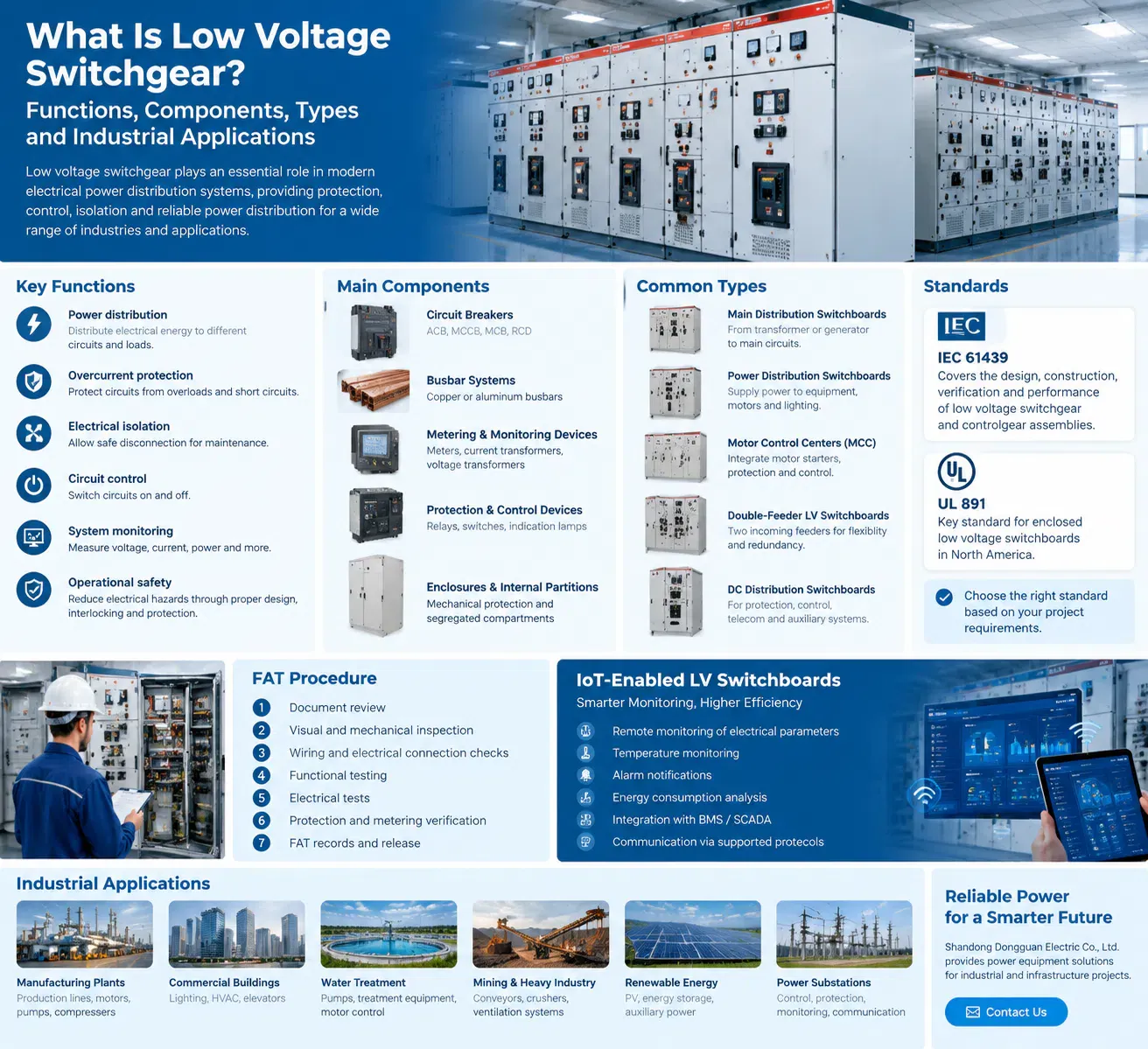
What Is Low Voltage Switchgear? Functions, Components, Types and Industrial Applications
Low voltage switchgear plays an essential role in modern electrical power distribution systems. It helps protect electrical equipment, control power circuits, isolate faulty sections, and ensure a stable and reliable power supply for industrial and commercial facilities.
Understanding what is LV switchboard technology and how low voltage switchgear operates is important when selecting electrical distribution equipment for factories, commercial buildings, infrastructure projects, and power substations.
As a power equipment solutions provider, Shandong Dongguan Electric Co., Ltd. supplies electrical equipment solutions designed to meet different project requirements, applicable IEC standards, and customer-specific specifications.
1. What Is Low Voltage Switchgear?
Low voltage switchgear is an electrical assembly used to control, protect, isolate, and distribute electrical power in low voltage systems. According to IEC 61439, low voltage switchgear and controlgear assemblies are generally designed for circuits with rated voltages not exceeding 1,000 V AC or 1,500 V DC, subject to the applicable product standard.
A typical LV switchboard receives electrical power from a transformer, generator, or another power source and distributes it to downstream loads through individual outgoing circuits.
The primary functions of LV switchgear include:
- Power distribution: Distributing electrical energy to different circuits and loads.
- Overcurrent protection: Protecting circuits against overloads and short circuits.
- Electrical isolation: Allowing equipment to be safely disconnected for maintenance.
- Circuit control: Switching electrical circuits on and off.
- System monitoring: Measuring voltage, current, power, and other electrical parameters.
- Operational safety: Helping reduce electrical hazards through appropriate design, interlocking, and protection measures.
The function of LV switchboard in an electrical power distribution system is therefore not limited to distributing electricity. It also supports system protection, operational control, monitoring, and maintenance.
2. Main Components Inside LV Switchboards
The components inside LV switchboards depend on the rated current, short-circuit withstand requirements, distribution arrangement, and application. Common components include the following.
2.1 Circuit Breakers
Circuit breakers are among the most important components inside LV switchboards. They interrupt current under specified fault conditions and provide switching and isolation functions according to their design.
Common types include:
- Air circuit breakers (ACBs) for main incoming and high-current distribution circuits.
- Molded case circuit breakers (MCCBs) for feeder and branch circuit protection.
- Miniature circuit breakers (MCBs) for smaller distribution circuits.
- Residual current devices (RCDs), where required, for additional protection against residual currents.
The selection of circuit breakers depends on rated current, breaking capacity, coordination requirements, and the characteristics of the connected load.
2.2 Busbar Systems
Busbars distribute electrical power from incoming circuits to outgoing feeders. Copper or aluminum busbars may be selected according to electrical ratings, temperature-rise limits, mechanical strength, and project requirements.
2.3 Metering and Monitoring Devices
Meters, current transformers, voltage transformers where applicable, and multifunction power meters help operators monitor system performance.
2.4 Protection and Control Devices
Protection relays, control switches, indication lamps, and auxiliary relays support circuit control and system protection.
2.5 Enclosures and Internal Partitions
The enclosure provides mechanical protection and helps prevent unintended contact with live parts. Depending on the design, the assembly may include internal barriers, separate compartments, cable chambers, and specified degrees of ingress protection.
A properly engineered LV switchboard assembly integrates these components into a complete distribution system. The final configuration should be verified against the approved technical drawings and applicable assembly standards.
3. Common Types of LV Switchboards
Different applications require different low voltage distribution arrangements.
3.1 Main Distribution Switchboards
Main distribution switchboards receive power from transformers, generators, or other sources and distribute it to major downstream circuits.
They are commonly installed in industrial plants, commercial buildings, and substations.
3.2 Power Distribution Switchboards
These assemblies supply power to production equipment, motors, lighting systems, and other electrical loads.
3.3 Motor Control Centers
Motor control centers integrate motor starters, protective devices, control circuits, and related equipment into a centralized assembly.
They are widely used in manufacturing plants, water treatment facilities, mining operations, and process industries.
3.4 Double-Feeder LV Switchboards
A double-feeder LV switchboard uses two incoming supply circuits or feeders according to the system design. Depending on the application, it may include bus-section arrangements and electrical or mechanical interlocking.
The purpose is to support supply flexibility or redundancy. However, the actual reliability depends on the source configuration, transfer scheme, protection coordination, and operating procedures.
3.5 DC Distribution Switchboards
DC switchboards distribute direct current to loads such as protection systems, control equipment, telecommunications equipment, and substation auxiliary systems.
DC distribution panels require suitable DC-rated circuit breakers and components because DC fault interruption differs from AC interruption.
4. IEC and UL Standards for LV Switchboards
Choosing the correct standard is an important part of switchboard procurement.
IEC 61439
The IEC 61439 series covers low voltage switchgear and controlgear assemblies. It addresses assembly design, construction, verification, and performance requirements.
IEC-based LV switchboards are widely used in industrial facilities, commercial buildings, power distribution networks, and international infrastructure projects.
UL 891
UL 891 is a key North American standard for dead-front switchboards. Buyers seeking the best UL891 LV switchboards USA suppliers should verify the manufacturer's relevant certifications, the exact product's listing or certification status, and its suitability for the intended application.
When comparing the best brands for UL891 LV switchboards, evaluate more than brand reputation. Important factors include:
- Compliance with the required UL standard.
- Available rated current and short-circuit ratings.
- Busbar and enclosure design.
- Protection and metering options.
- Documentation and technical support.
- Delivery time, service capability, and total project cost.
A China LV switchboard manufacturer may offer competitive pricing and customization for international projects. However, IEC compliance alone does not establish UL 891 compliance. If a project specifies UL 891, buyers should confirm the exact certification and acceptance requirements before placing an order.
5. LV Switchboard Assembly and Design Considerations
A reliable LV switchboard assembly begins with a clear understanding of the electrical system and operating conditions.
Before manufacturing, engineers typically review:
- Rated operational voltage and frequency.
- Main busbar and feeder current ratings.
- Prospective short-circuit current.
- Incoming and outgoing feeder quantities.
- Circuit breaker types and trip settings.
- Earthing and neutral arrangements.
- Cable entry and exit directions.
- Enclosure protection rating.
- Installation environment and ambient temperature.
- Communication, monitoring, and automation requirements.
The design process normally includes single-line diagrams, general arrangement drawings, wiring diagrams, component schedules, and other documents required by the project.
For customers reviewing an LV switchboard catalogue, it is important to check the technical ratings and available configurations rather than relying on product appearance alone.
A reference to LV switchboard assembly part 2 may describe a continuation of an assembly guide or a specific section of a technical document. When reviewing such materials, buyers should ensure that all parts refer to the same assembly design and approved specifications.
6. Factory Acceptance Test (FAT) Procedure of LV Switchboards
A factory acceptance test verifies specified aspects of a switchboard before shipment. The exact FAT procedure depends on the applicable standard, contract, approved inspection and test plan, and customer requirements.
A typical factory acceptance test FAT procedure of LV switchboards may include the following steps.
Step 1: Document Review
Check the approved drawings, bill of materials, component ratings, wiring diagrams, and relevant technical specifications.
Step 2: Visual and Mechanical Inspection
Inspect the enclosure, busbars, wiring, labels, component installation, earthing connections, and mechanical operation.
Step 3: Wiring and Electrical Connection Checks
Verify control wiring, terminal connections, circuit identification, and the specified connection arrangements.
Step 4: Functional Testing
Operate circuit breakers, control switches, indication lamps, interlocks, and other control functions as applicable.
Step 5: Electrical Tests
Perform the applicable routine verification and electrical tests required by the relevant standard and approved inspection plan. The test scope may include protective circuit continuity, insulation-related checks, and dielectric verification where applicable.
Test methods and acceptance criteria must be selected according to the assembly design and the manufacturer's approved procedures. Insulation resistance measurements alone do not replace other required verification.
Step 6: Protection and Metering Verification
Check the installation and settings of protection devices and verify metering indications and control functions as required.
Step 7: FAT Records and Release
Record test results, document any nonconformities, complete corrective actions, and obtain the required approvals before shipment.
A clear FAT procedure for LV switchboards helps improve inspection efficiency and ensures that the manufacturer and customer share the same acceptance criteria.
For projects requiring a customer witness inspection, the FAT schedule and inspection scope should be agreed upon in advance.
7. Smart Technology: IoT-Enabled LV Switchboards
Digital monitoring is becoming increasingly important in modern power distribution systems.
IoT-enabled LV switchboards can integrate smart meters, communication gateways, temperature sensors, and monitoring devices to collect electrical and operational data.
Typical capabilities include:
- Remote monitoring of voltage, current, power, and energy consumption.
- Monitoring of selected equipment temperatures.
- Alarm notifications for abnormal operating conditions.
- Energy consumption analysis.
- Integration with building management systems or industrial supervisory systems.
- Communication with SCADA or energy management platforms through supported protocols.
The term IoT-enabled LV switchboards is also sometimes written as IoT enabled LV switchboards or IoT-enabled low voltage switchboards.
These technologies can improve visibility into electrical system performance and help maintenance teams identify potential problems earlier. Their actual benefits depend on sensor selection, data quality, cybersecurity measures, communication infrastructure, and integration with the customer's monitoring platform.
8. Industrial Applications of Low Voltage Switchgear
Low voltage switchgear is used in a wide range of electrical distribution applications.
Manufacturing Plants
LV switchboards distribute power to production lines, motors, pumps, compressors, and auxiliary equipment.
Commercial Buildings
They supply lighting, HVAC systems, elevators, and general electrical loads.
Water Treatment and Wastewater Facilities
LV switchgear supports pump stations, treatment equipment, motor control, and auxiliary systems.
Mining and Heavy Industry
Robust distribution assemblies supply crushers, conveyors, ventilation systems, and other heavy-duty equipment.
Renewable Energy Projects
LV distribution equipment is used in photovoltaic installations, energy storage systems, and auxiliary power systems, subject to the relevant system design.
Power Substations
LV switchboards and DC distribution panels provide auxiliary AC and DC power for control, protection, monitoring, and communication systems.
For each application, equipment selection should consider load characteristics, fault levels, environmental conditions, maintenance requirements, and the applicable electrical standards.
9. How to Choose the Right LV Switchboard Manufacturer
When evaluating an LV switchboard supplier, buyers should consider several key factors.
Technical capability: Can the manufacturer meet the required current ratings, short-circuit ratings, protection requirements, and installation conditions?
Standards and verification: Can the supplier provide the relevant design verification, routine verification records, and certification evidence required by the project?
Customization: Can the manufacturer accommodate the required number of feeders, metering devices, communication functions, enclosure dimensions, and cable arrangements?
Quality control: Does the factory have documented assembly, inspection, testing, and traceability procedures?
Project documentation: Can the supplier provide approved drawings, component lists, operation manuals, test reports, and export documentation as required?
Commercial terms: Compare the total cost, delivery schedule, packaging, warranty, spare parts, and after-sales support.
For international projects, customers should confirm the required standards and technical specifications before requesting a final quotation. This helps reduce design changes, approval delays, and procurement risks.
10. Conclusion
Low voltage switchgear is a fundamental part of electrical power distribution. It combines switching, protection, isolation, monitoring, and control functions in an integrated assembly.
Understanding what is LV switchboard technology, the components inside LV switchboards, the differences between IEC and UL requirements, and the factory acceptance test procedure of LV switchboards helps buyers make more informed procurement decisions.
As industrial facilities increasingly adopt digital monitoring and energy management, IoT-enabled LV switchboards are also becoming an important option for improving operational visibility.
Shandong Dongguan Electric Co., Ltd. provides power equipment solutions for industrial and infrastructure projects. Contact our team to discuss your LV switchboard requirements, technical specifications, and project-specific configuration.
Shandong Dongguan Electric Co., Ltd.
Power Equipment Solutions Provider
Website: https://www.dongguanelectric.com