

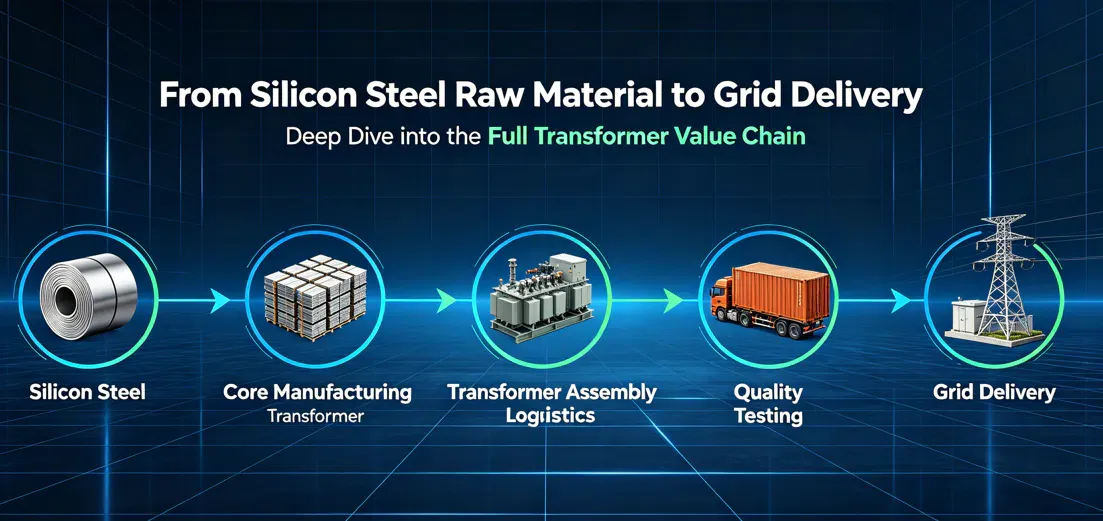

China has become the world’s largest producer of transformers, with production capacity accounting for approximately 60% of the global total, and has established a fully integrated and self-sufficient industrial chain for transformer manufacturing—from raw minerals to complete finished products.
The upstream segment of the transformer industry chain consists of raw materials, including steel, grain-oriented silicon steel, non-ferrous metals, electromagnetic wires, insulating materials, and impregnating materials. China is the world’s largest producer of copper and steel, enabling a stable supply of key materials such as grain-oriented silicon steel, copper conductors, and insulating paperboard. In 2024, China’s steel output was approximately 1.399 billion tons, and grain-oriented silicon steel production reached about 3 million tons; production is forecast to reach 3.35 million tons in 2025. Thanks to its well-developed industrial chain, China’s transformer industry achieves over 90% self-sufficiency in key upstream raw materials such as copper and grain-oriented silicon steel. On this basis, Chinese manufacturers have a delivery cycle of only 10 to 12 months, which can be shortened to 8 months for urgent orders, significantly faster than the 18 months to 2 years typical of European and American manufacturers.
The midstream segment of the industry consists of different types of transformers, including power transformers, distribution transformers, special-purpose transformers, and instrument transformers. In 2024, China’s total transformer output is expected to reach 19.5 trillion volt-amperes, an increase of 11% year-on-year; production is projected to approach 20 trillion volt-amperes in 2025. In terms of exports, China’s transformer export value reached RMB 64.6 billion in 2025, up nearly 36% from 2024. The average export price per transformer rose to RMB 205,000 in 2025, about one-third higher than the previous year. The order structure is clearly shifting toward high-end, high-value-added products such as large power transformers used in ultra-high-voltage transmission projects and newly designed products tailored for artificial intelligence data centers.
In terms of listed companies in the A-share market, Guangdong Province has the largest number (10 companies), followed by Jiangsu Province (6 companies), while Shandong and Zhejiang Provinces each have 5 companies. Driven by surging global demand from AI computing infrastructure, energy transition, and power grid upgrades, many domestic transformer factories are operating at full capacity, and some orders for data center applications have been scheduled through 2027. In response to the surge in orders, transformer companies are strengthening coordination with upstream and downstream partners: upstream, they are establishing long-term stable cooperation with suppliers of silicon steel and copper materials to ensure supply stability and cost control; downstream, they are forming deep partnerships with power grid companies, data center operators, and renewable energy project developers to secure orders in advance and carry out targeted R&D closely aligned with market demand.
The downstream applications of the industry include power grids, rail transit, wind power, solar power, electric vehicle charging infrastructure, and industrial manufacturing. In 2024, total electricity consumption across society reached 98,521 billion kWh, up 6.8% year-on-year. Newly installed wind power capacity in China reached 86.99 million kilowatts in 2024. By the end of 2024, the number of public charging stations nationwide reached 3.579 million.
In addition, the global AI computing infrastructure (data center) construction boom is driving explosive growth in demand. The requirement for high-power and highly stable electricity supply is upgrading transformers into a core component of computing infrastructure, creating a significant incremental market.
The industry is also evolving toward energy efficiency (e.g., three-dimensional wound core transformers that reduce no-load losses), environmental friendliness (e.g., natural ester insulating oil transformers), and intelligence (e.g., integrated online monitoring and AI-based diagnostics).