

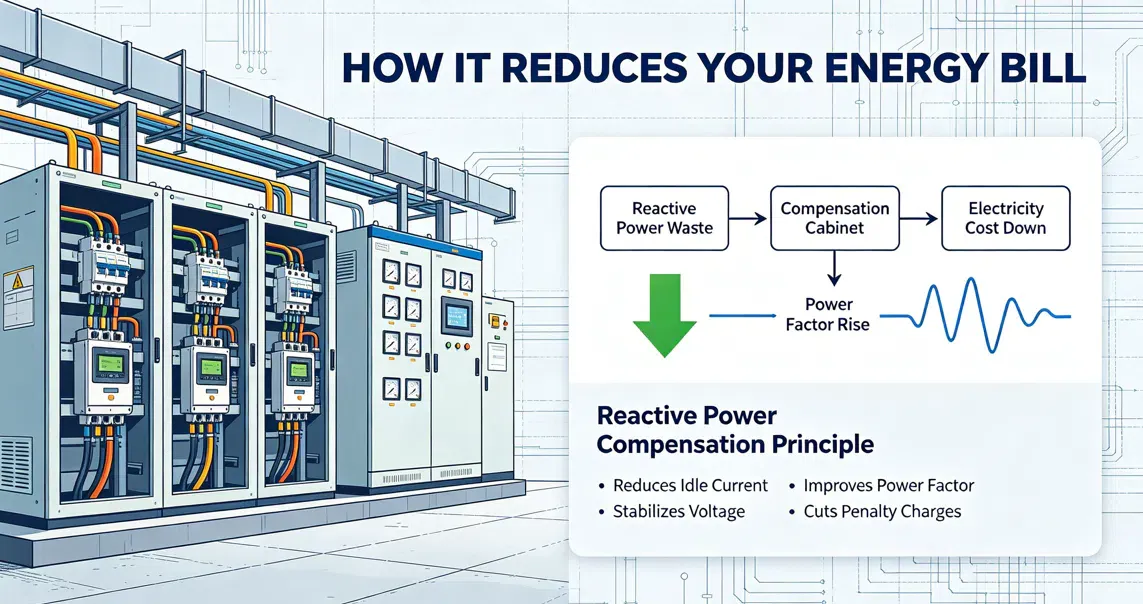
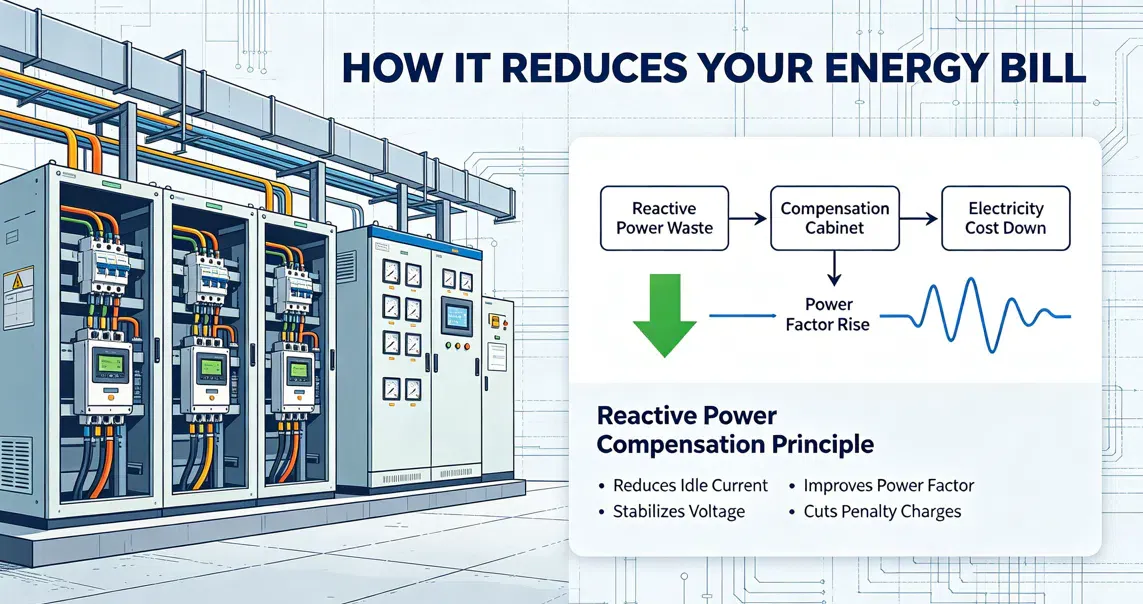
Reactive Power Compensation Cabinets are primarily used to improve power efficiency, reduce electricity costs, and help factories avoid penalties caused by a low power factor. By automatically regulating capacitor banks, they help maintain a more stable power grid.
Main Functions
1.Improve Power Factor
Enables more efficient utilization of electrical energy and helps avoid penalties imposed by utility companies for a low power factor.
2.Reduce Line Losses
Minimizes heat losses caused by current transmission, thereby lowering electricity costs.
3.Enhance Voltage Quality
Stabilizes grid voltage, reduces voltage fluctuations that may affect equipment lifespan, and improves power supply reliability.
4.Increase Equipment Capacity
Allows more active loads to be connected without increasing transformer capacity, maximizing the utilization of existing equipment.
How It Works
1.Compensating Reactive Current
Motors and other industrial equipment are inductive loads that consume reactive power. The compensation cabinet connects capacitors in parallel to generate capacitive reactive power, which offsets the inductive reactive power.
2.Automatic Switching and Regulation
The controller continuously monitors the phase difference between voltage and current. When reactive power demand increases, capacitor banks are automatically switched in; when demand decreases, they are switched out, maintaining an optimal balance.
3.Local Reactive Power Compensation
Reactive power is compensated close to the load rather than being transmitted through the grid over long distances. This reduces the burden on transformers and distribution lines, improving overall system efficiency.