

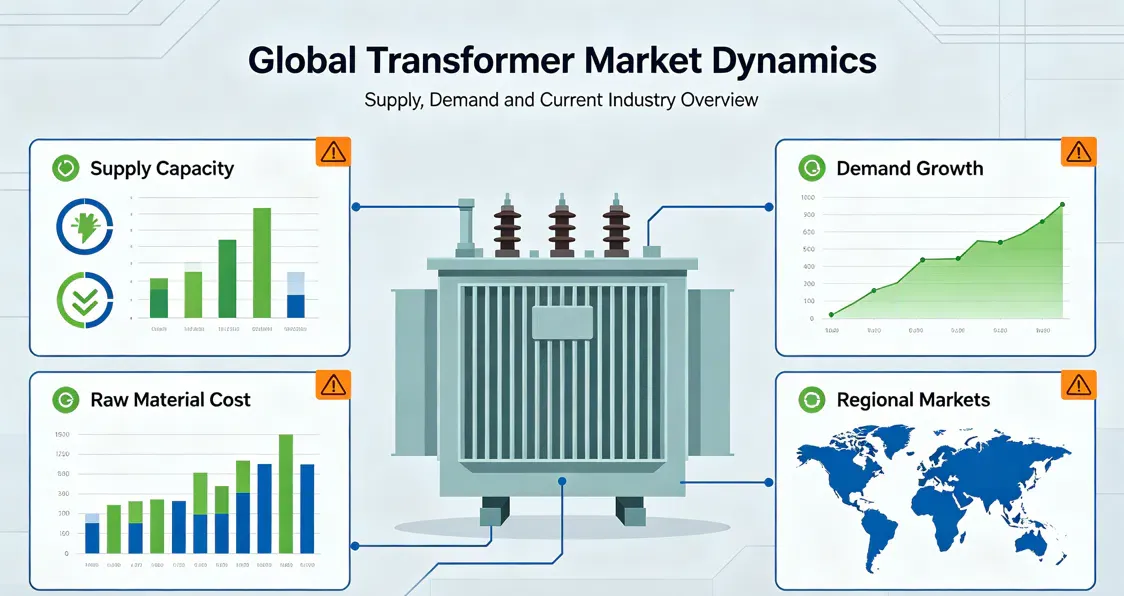
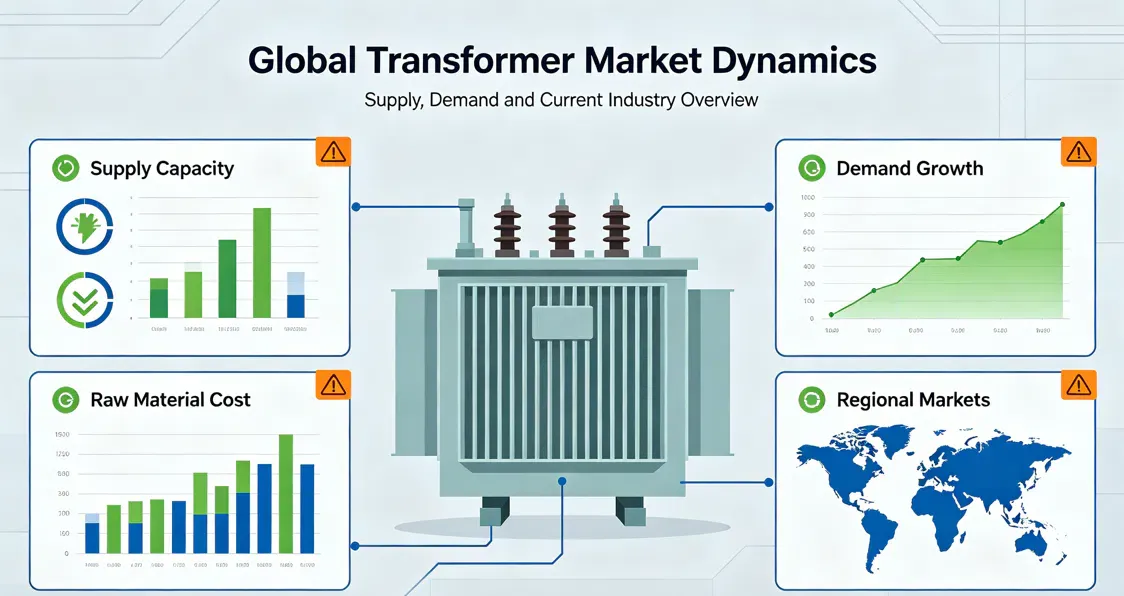
By 2025, China had become the world's largest transformer producer, accounting for approximately 60% of global production capacity. It has established a relatively comprehensive global transformer manufacturing system and achieved full self-sufficiency and control over the entire industrial chain. The Chinese transformer industry comprises about 3,000 enterprises.
In terms of upstream raw materials, the self-sufficiency rate for key materials such as copper and grain-oriented silicon steel exceeds 90%. Chinese manufacturers offer delivery lead times of 10 to 12 months, with rush orders compressible to 8 months—significantly faster than the 18-month-plus cycles typical of European and American counterparts. The industry possesses core competitiveness in technological iteration and scenario-specific adaptation, while its globalization footprint continues to expand.
The competitive landscape is shifting toward technological innovation, delivery capability, and global deployment. At the same time, the industry faces challenges including high R&D expenditures, raw material cost pressures, and geopolitical risks.
Currently, numerous transformer factories in China's Guangdong Province, the Yangtze River Delta, and other regions are operating at full capacity. Some orders, particularly those serving data center projects, have been scheduled through 2027. The surge in global transformer demand is primarily driven by power grid upgrades, the expansion of artificial intelligence computing capacity, and the integration of new energy sources into the grid. Domestic leading enterprises have full order books, with their order mix shifting toward high-end, higher-value-added products.
In 2025, China's total transformer export value reached RMB 64.6 billion, up nearly 36% year-on-year, setting a new record. The average export price rose to approximately RMB 205,000 per unit (about USD 20,800 per unit), reflecting enhanced product value-added. By regional market, exports to Asia grew by 65.39%, to Africa by 28.03%, and to Europe by over 138%. Notable demand growth was also observed in the U.S., Europe, and the Middle East, driven by energy transition, manufacturing reshoring, and the development of emerging industries.